

The DC side of a battery energy storage system (BESS) is protected by a battery protection box — an IP-rated enclosure installed between the battery bank and the inverter or power conversion system (PCS) that houses a busbar together with DC circuit breakers (DC MCB and DC MCCB). This box provides three functions: safe disconnection for maintenance, overcurrent protection against short-circuit and overload faults, and a defined isolation point during emergencies. Because a BESS operates at DC 250 V to 1500 V — all within the low-voltage class under IEC definitions — the protection devices must be DC-rated: standard AC breakers cannot safely interrupt a DC fault. Correctly sizing this DC-side protection to the system voltage, current, and string count is what keeps a storage installation safe, serviceable, and compliant. The sections below explain what goes inside the box, why DC protection differs from AC, and how to choose the right configuration and enclosure.
Why the DC Side of a BESS Needs Dedicated Protection
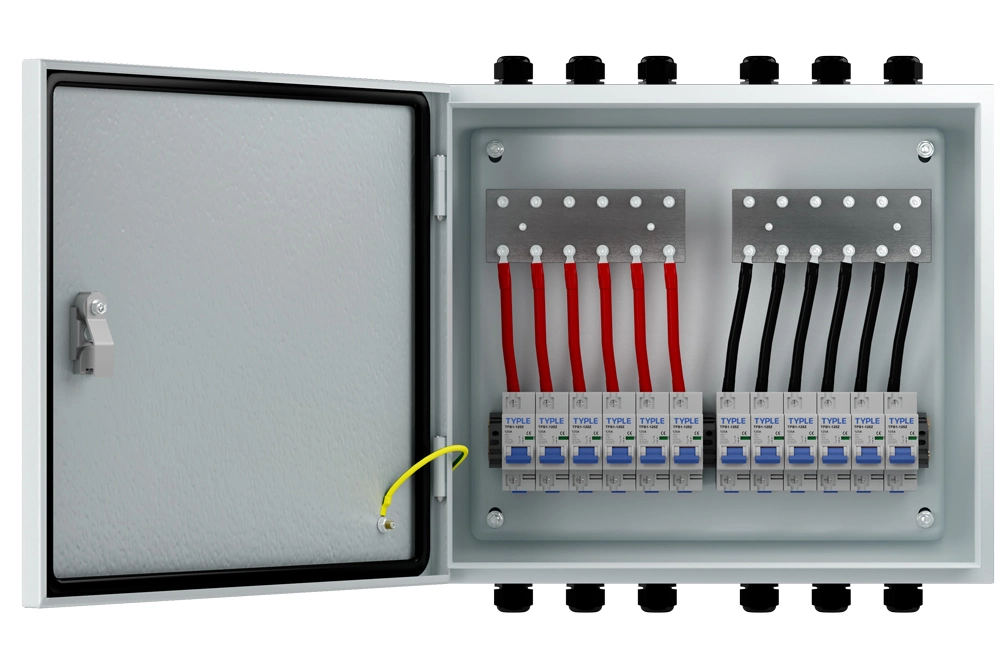
A BESS stores large amounts of energy at a continuous DC voltage, and that changes the protection problem compared with ordinary AC distribution. The most important difference is arc behaviour: an AC fault current naturally passes through zero 100–120 times per second, which helps an arc self-extinguish, but DC current is continuous and does not cross zero. A DC arc therefore sustains itself and burns hotter for longer, capable of igniting cable insulation or adjacent components if it is not interrupted by a device designed for DC. This is why every disconnection and overcurrent device on the battery side must carry a DC rating matched to the system voltage.
The second factor is energy density. A battery bank can deliver very high fault current almost instantly, so the protection has to clear faults quickly and reliably at the full DC voltage. The third factor is duty: BESS switching, charge/discharge cycling, and BMS operation generate frequent internal transients over the system’s life, so the DC-side protection has to tolerate repeated operation without degrading. A dedicated battery protection box addresses all three by grouping DC-rated devices into one coordinated enclosure rather than relying on scattered single components.
What’s Inside a Battery Protection Box
busbar that distributes DC current inside the enclosure, with circuit breakers connected for branch and main-circuit protection. TYPLE configures these boxes with two breaker types working together:
- DC MCB (miniature circuit breaker): branch-level overcurrent protection for individual strings or circuits, engineered to align with IEC 60947-2.
- DC MCCB (moulded case circuit breaker): main disconnection and higher-current protection for the overall battery link, also engineered to align with IEC 60947-2.
The complete assembly is engineered to align with IEC 61439, with component-level certificates available through certified supply-chain partners. For a full breakdown of the categories of DC protection devices used across combiner and storage enclosures, see our battery protection box category page, which lists the available series and configurations.
This busbar-plus-breaker arrangement is deliberately simple: fewer device types mean fewer coordination points and a lower chance of a mismatched rating. Where a project also requires surge protection on the DC bus, a DC SPD (engineered to align with IEC 61643-31) can be added, but the core protection chain for most battery banks is busbar, DC MCB, and DC MCCB.
How to Size DC Protection for a BESS
Sizing the DC side of a BESS comes down to three parameters, and matching all three to your single-line diagram is what avoids both safety risk and overspending.
By DC voltage. The protection box and every device inside it must be rated at or above the system’s maximum DC voltage. Common BESS classes are DC 250 V, 500 V, 1000 V, and 1500 V — all low voltage under IEC, so “1500 V” is a low-voltage rating, not a high-voltage one. Running a box above its rated voltage is unsafe because the breakers are not designed to clear faults at the higher stress.
By rated current. The main breaker and busbar must carry the maximum continuous charge/discharge current with margin. TYPLE battery protection boxes cover rated currents from 63 A up to 800 A depending on voltage class, so the same platform scales from small commercial systems to utility-scale banks.
By string count. The number of battery inputs and outputs sets the box size and internal layout. Configurations range from a single 1-in / 1-out branch box up to 9-in / 9-out assemblies, plus 1-in / multi-out distribution variants for splitting one battery source across several circuits.
Get these three right and the enclosure size, breaker ratings, and busbar follow. TYPLE builds each unit to the project single-line diagram, so the specification does not have to be forced into a fixed catalogue part.
IP65 vs IP68: Choosing the Enclosure
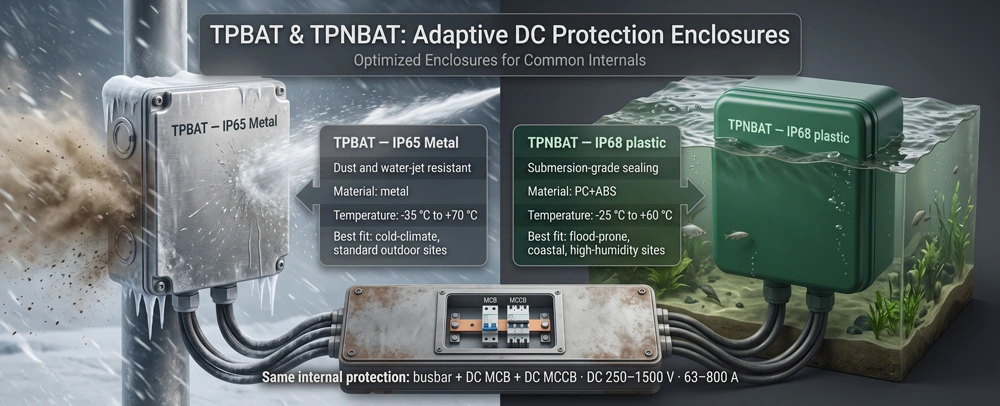
Two batteries systems with identical electrical ratings can still need different enclosures, because the site environment decides the ingress protection and material. TYPLE offers two enclosure platforms:
IP65 metal (TPBAT series): a metal enclosure rated IP65 against dust and water jets, operating from −35 °C to +70 °C. The metal body and wide low-temperature range suit cold-climate and standard outdoor sites. See the TPBAT battery protection box for the full DC 250–1500 V, 63–800 A model range.
IP68 PC+ABS (TPNBAT series): an engineering-plastic enclosure rated IP68 for submersion-grade sealing, operating from −25 °C to +60 °C. The higher ingress rating suits flood-prone, coastal, and high-humidity installations.
The rule of thumb: choose by the worst environmental condition on site. If the risk is water immersion or salt-laden coastal air, the IP68 plastic enclosure is the safer choice; if the risk is extreme low temperature or mechanical robustness, the IP65 metal enclosure is better suited. Both carry the same internal busbar-plus-breaker protection, so the electrical performance is unchanged — only the enclosure changes.


