
A DC MCB and a DC isolator do two different jobs. A DC MCB (miniature circuit breaker) automatically trips to protect a circuit against overload and short-circuit currents, while a DC isolator manually disconnects a circuit so it can be worked on safely. They are built to different standards — DC MCBs to IEC 60947-2 and DC isolators to IEC 60947-3 — and in most solar PV and energy-storage systems you need both, not one instead of the other. This guide explains what each device does, compares them side by side, and shows how to specify the right DC protection for rooftop, ground-mount, and off-grid solar systems in hot climates.
What Does a DC MCB Do?
A DC MCB is an automatic overcurrent protection device that trips and interrupts a DC circuit when it detects an overload or a short-circuit, protecting cables and downstream equipment. Once the fault is cleared, the breaker can be reset by hand, so no replacement part is needed.
DC MCBs are built to align with IEC 60947-2 and are rated by DC voltage and current. Typical PV ratings are DC 600V or DC 1000V (both are low voltage under the IEC system, which defines DC up to 1500V as low voltage) and rated currents from 10A to 63A. For ungrounded PV strings, a 2-pole DC MCB is used so that both the positive and negative conductors are switched together. Two more numbers matter when specifying one: the tripping characteristic (B, C, or D curve, which sets how quickly it reacts to overcurrent) and the ultimate breaking capacity (Icu, for example 6kA, the largest fault current it can safely interrupt).
What Does a DC Isolator Do?
A DC isolator — also called a DC isolating switch or DC disconnector — is a manually operated switch that connects or disconnects a DC circuit under load, but it does not provide automatic overcurrent protection. Its job is safe, visible disconnection: it lets an installer de-energise part of the system for maintenance, fault-finding, or emergency shutdown.
DC isolators are built to align with IEC 60947-3, a different standard from the IEC 60947-2 used for circuit breakers. A key point for buyers: an isolator will not trip on an overload or short-circuit, so it cannot replace a fuse or an MCB for circuit protection. Many installation codes and inverter manufacturers require a DC isolator on the DC input side of the inverter and on the PV array, which is why it is a standard fixture in solar systems even though it performs no protective function itself. Like DC MCBs, isolators are rated for DC voltage class and current, and are commonly supplied as 2-pole or 4-pole units.For outdoor solar systems they are housed in weatherproof enclosures — for example, TYPLE’s waterproof DC isolator switch (TPYS7-40), an IP66 unit rated for DC 1200V in 2-pole and 4-pole configurations.
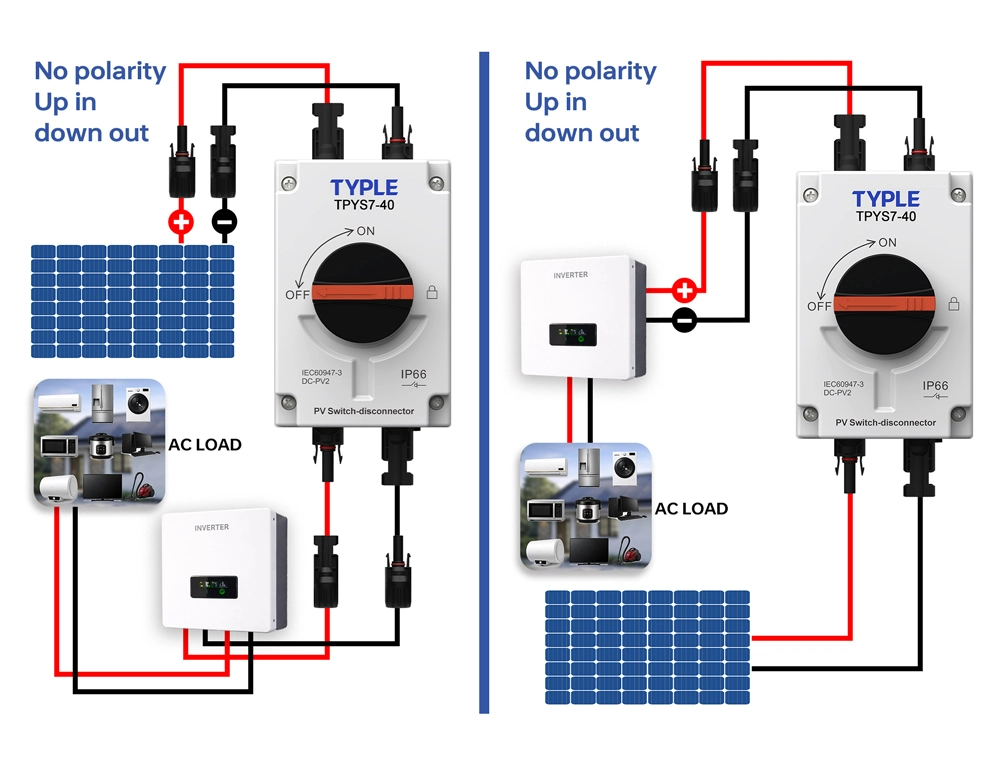
DC MCB vs DC Isolator: Side-by-Side Comparison
The clearest way to see the difference is by function: one protects, the other disconnects.
| Feature | DC MCB | DC Isolator |
|---|---|---|
| Primary function | Automatic overcurrent protection | Manual disconnection / isolation |
| Reference standard | IEC 60947-2 | IEC 60947-3 |
| Operation | Trips automatically on fault; manual reset | Operated manually (on / off) |
| Protects against overload & short-circuit | Yes | No |
| Safe disconnection for maintenance | Yes (it also switches) | Yes (its main purpose) |
| Typical position in system | String / branch / feeder protection | Main DC disconnect at inverter, array, or battery |
| Poles (PV use) | 2-pole (isolates + and −) | 2-pole / 4-pole |
| Voltage class | Low voltage, DC ≤1500V (e.g. DC600V / DC1000V) | Low voltage, DC ≤1500V |
| Resettable / reusable after a fault | Yes, reset by hand | Not applicable (no trip) |
Do You Need Both a DC MCB and a DC Isolator?
In most solar PV and battery-storage systems you need both a DC MCB and a DC isolator, because they solve different problems: overcurrent protection versus safe manual disconnection. Treating them as alternatives is a common specification mistake — an isolator gives you a way to switch the system off, but nothing to stop a fault current, while an MCB stops a fault but is not always positioned where an installer needs a service disconnect.
On the PV array and string side
Each string is protected against reverse and overcurrent by a fuse or a DC MCB, while an isolator provides the point where the array can be switched off. On larger systems these protection devices are usually grouped inside a combiner box, alongside surge protection.
At the inverter and battery DC side
A DC isolator is typically required here so the inverter or battery bank can be safely de-energised for maintenance, and DC MCBs protect individual battery branch circuits. In the Middle East, Africa, and Southeast Asia, both are commonly specified in outdoor, IP-rated enclosures to handle heat, dust, and UV. Exact requirements vary by national grid code, so always confirm against local regulations.
DC protection from TYPLE: For circuit-level DC overcurrent protection, TYPLE supplies both DIN-rail DC MCBs (TPB7-63) and ready-to-mount enclosed DC MCB boxes such as the TPX7-C3 — a 2-pole, DC 600V unit in an IP66/IK10 housing, engineered to align with IEC 60947-2.
How to Choose DC Protection for Your Solar Project
Choosing DC protection comes down to matching the device to the circuit’s voltage, current, and operating environment.
- Match the voltage class. Specify DC600V or DC1000V devices to match the system’s maximum DC voltage — see our guide on DC600V vs DC1000V combiner boxes for how string length drives this choice.
- Size the rated current to the string or branch current, with headroom for temperature derating in hot climates.
- Confirm the breaking capacity (Icu) is at or above the prospective fault current at the installation point.
- Specify the enclosure rating for outdoor sites — IP66 for ingress and IK10 for impact are typical for rooftop and ground-mount installations.
- Decide DIN-rail component vs enclosed box. A DIN-rail MCB fits inside a combiner box; an enclosed DC MCB box is a standalone, weatherproof unit for a single circuit.
For a full picture of how these devices sit together, see our complete solar combiner box guide.
Send us your product model or project requirements — our engineering team will reply with a tailored quotation and confirmed lead time within 24 hours.
Published by the TYPLE Electric Technical Team. TYPLE is a Wenzhou-based manufacturer of PV combiner boxes and DC protection components for solar and energy storage systems.


