
By Chris Huang, Product & Sourcing Manager

To get an accurate, actionable commercial quotation for a solar PV combiner box within 24 hours, an Engineering, Procurement, and Construction (EPC) contractor or distributor must provide 5 core technical parameters: the maximum system DC voltage, the exact number of string inputs and outputs, the preferred internal protection component configurations, the enclosure material required for site environmental conditions, and any specialized monitoring or custom wiring needs. When sourcing components from China’s manufacturing hubs like Liushi, vague requests such as “Please quote for a 6-string solar box” often lead to delayed responses, generic estimates, or costly technical mismatches during onsite installation. The structured checklist below details the precise specifications required by factory engineering teams to deliver an exact technical proposal and a firm lead-time commitment.
1. System Voltage and Circuit Infrastructure
The electrical architecture of the solar array dictates the internal spacing, component ratings, and insulation levels of the combiner box.
- Maximum System DC Voltage ($V_{oc}$):
State clearly whether the system operates at DC 500V, DC 1000V, or DC 1500V. This determines the voltage rating required for the DC Molded Case Circuit Breakers (MCCB), Surge Protective Devices (SPD), and fuse links. - Input and Output Configuration:
Specify the exact array routing. For example, a “6 In 1 Out” configuration means 6 separate string inputs are combined into a single main DC output copper busbar. - Rated Current per String ($I_{sc}$):
Standard inputs typically range from 15A to 30A per string. Specifying this ensures the factory selects the correct fuse holder dimensions and wire cross-sections to prevent thermal overload.
2. Internal Component Specifications
A combiner box is an assembly of protective devices. Specifying the component types reduces the back-and-forth communication between procurement and the factory engineering team.
| Component Block | Required Specifications to Provide | Aligned Reference Standards |
| DC Fuses | Amperage rating (e.g., 15A, 20A, 32A) and whether protection is needed on both positive and negative poles. | IEC 60269-6 |
| Surge Protection | Type 1+2 or Type 2 DC SPD, maximum continuous operating voltage ($U_{cpv}$), and discharge current ($I_{n}$ / $I_{max}$). | IEC 61643-31 |
| Main Isolation / Breaker | DC Isolating Switch (Load Break Switch) or DC Molded Case Circuit Breaker (MCCB); state if a shunt trip or auxiliary contact is required. | IEC 60947-2 |
| Anti-Feedback Diodes | Specify if the project requires diode blocks to block reverse currents in shaded arrays. | Factory Standard |
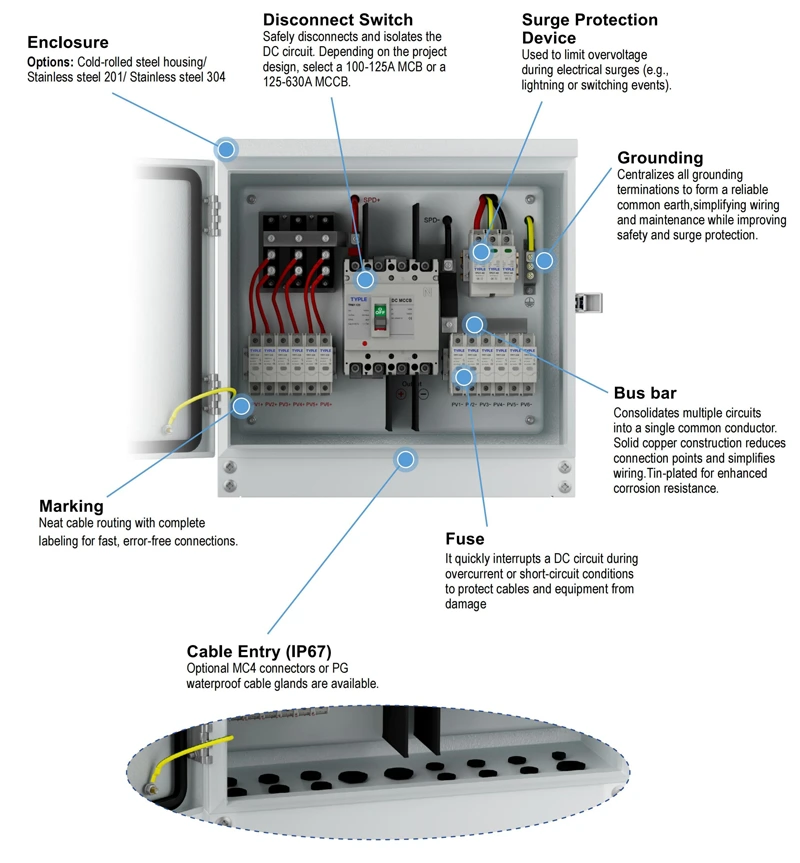
3. Enclosure Material and Environmental Ratings
The physical location of the solar installation dictates the required mechanical protection for the box enclosure.
- Polycarbonate (PC) / ABS:
Ideal for standard commercial rooftops where light weight, UV resistance, and cost-efficiency are prioritized. - Glass-Fiber Reinforced Polyester (GRP):
Highly recommended for harsh environments, such as desert utility-scale plants or coastal areas with high
salinity, due to superior impact resistance and thermal stability. - Ingress Protection (IP) Rating:
For outdoor solar installations, a minimum of
IP65
per IEC 60529 is standard to ensure the enclosure remains dust-tight and protected against water jets.
4. Cable Entry and Termination Details
To ensure seamless field wiring, the factory must prep the enclosure layout to match the site cables.
- Cable Glands vs. MC4 Connectors:
Specify if the string inputs should use pre-installed MC4 waterproof connectors for plug-and-play installation, or
standard compression cable glands (e.g., PG9) for direct cable termination. - Output Cable Sizes:
Provide the cross-sectional area (e.g., $35\text{ mm}^2$, $50\text{ mm}^2$, or $70\text{ mm}^2$) of the main DC
cable running to the inverter. This allows engineers to install the correct size of output cable glands and
mechanical lugs.
5. Smart Monitoring and Custom Requirements
If the project requires integration with a centralized SCADA system, specify the monitoring parameters:
- Smart Monitoring Unit:
State if the box needs to measure individual string currents, busbar voltage, internal temperature, and the status
of the SPD and circuit breaker. - Communication Protocol:
The factory standard is typically Modbus-RTU via an RS485 interface. - Pre-wiring Customization:
If your engineering team requires specific layout spacing, particular color-coded internal wiring, or customized
grounding arrangements, share these requirements alongside the initial technical inquiry.
Sourcing Note from Liushi Hub:
When requesting custom designs, providing a single-line diagram (SLD) or a rough schematic layout along with your
inquiry cuts technical review times down by 50%, allowing factories to fast-track your commercial quotation.
Summary Checklist for RfQ Submission(EPC Procurement Checklist)
Copy and fill out this quick template when sending your next inquiry to ensure a rapid commercial response:
1. Project Location / Application Environment: [e.g., Desert Utility / Coastal Rooftop]
2. Maximum System Voltage: [e.g., DC 1000V / DC 1500V]
3. Configuration: [e.g., 12 Inputs / 1 Output]
4. Input Protection: [e.g., 15A Fuses on Both Poles]
5. Output Disconnect: [e.g., 250A DC MCCB with Shunt Trip]
6. Surge Protection: [e.g., Type 2 DC SPD, 1000V]
7. Enclosure Material & IP Rating: [e.g., GRP Box, IP65]
8. Input Termination: [e.g., Pre-installed MC4 Connectors]
9. Smart Monitoring: [e.g., Yes, RS485 Modbus String Monitoring / No]
Get Your Quote Within 24 Hours
Send us your product model or project requirements — our engineering team will reply with a tailored quotation and confirmed lead time within 24 hours.


