
The number of poles a DC circuit breaker needs is set by the system voltage and the breaker’s per-pole voltage rating, not by the current. Each pole withstands a fixed DC voltage, the poles are wired in series, and the total voltage the breaker can handle is the per-pole rating multiplied by the number of poles. Divide your system voltage by the per-pole rating, round up to whole poles, and that is your answer.
The catch is that the per-pole rating is not always the same, even within one product family. Two breakers can both carry a “1000 V DC” label while using a different number of poles to reach it. That is where most sizing mistakes happen. This guide explains why DC breakers need series poles at all, how to read a per-pole rating, and how to pick the right pole count for any DC MCB or DC MCCB from 500 V up to 1500 V.

Why DC Circuit Breakers Need More Poles Than AC
A DC circuit breaker often needs two to four poles for a single circuit because breaking a DC arc is harder than breaking an AC arc, and wiring poles in series shares the voltage and helps extinguish the arc. AC current crosses zero 100 or 120 times a second, and the arc self-extinguishes at each crossing. DC has no zero crossing.
When any breaker opens under load, an arc forms across the separating contacts. In AC that arc dies at the next current zero. In DC the current is continuous, so the arc keeps burning until the breaker physically stretches, cools and splits it inside the arc chute. The higher the DC voltage, the more energy in that arc, and the harder it is to clear.
The engineering solution is to put more breaking gaps in the current path. A single pole reliably interrupts DC up to its rated per-pole voltage. To handle a higher system voltage, two or more poles are wired in series in the same circuit, so each pole carries only a share of the total voltage and the arc is broken in stages across multiple contacts. This is why a DC breaker protecting a 1000 V array can use all four of its poles on one positive-and-negative circuit, where an AC breaker of the same size would protect a four-wire three-phase system.
How a Per-Pole Voltage Rating Works
A DC circuit breaker’s maximum system voltage equals its per-pole voltage rating multiplied by the number of poles in series. A breaker rated 300 V per pole reaches 600 V with 2 poles and 1200 V with 4; a 250 V-per-pole breaker reaches 500 V with 2 poles and 1000 V with 4; a 500 V-per-pole breaker reaches 1000 V with 2 poles and 1500 V with 3.
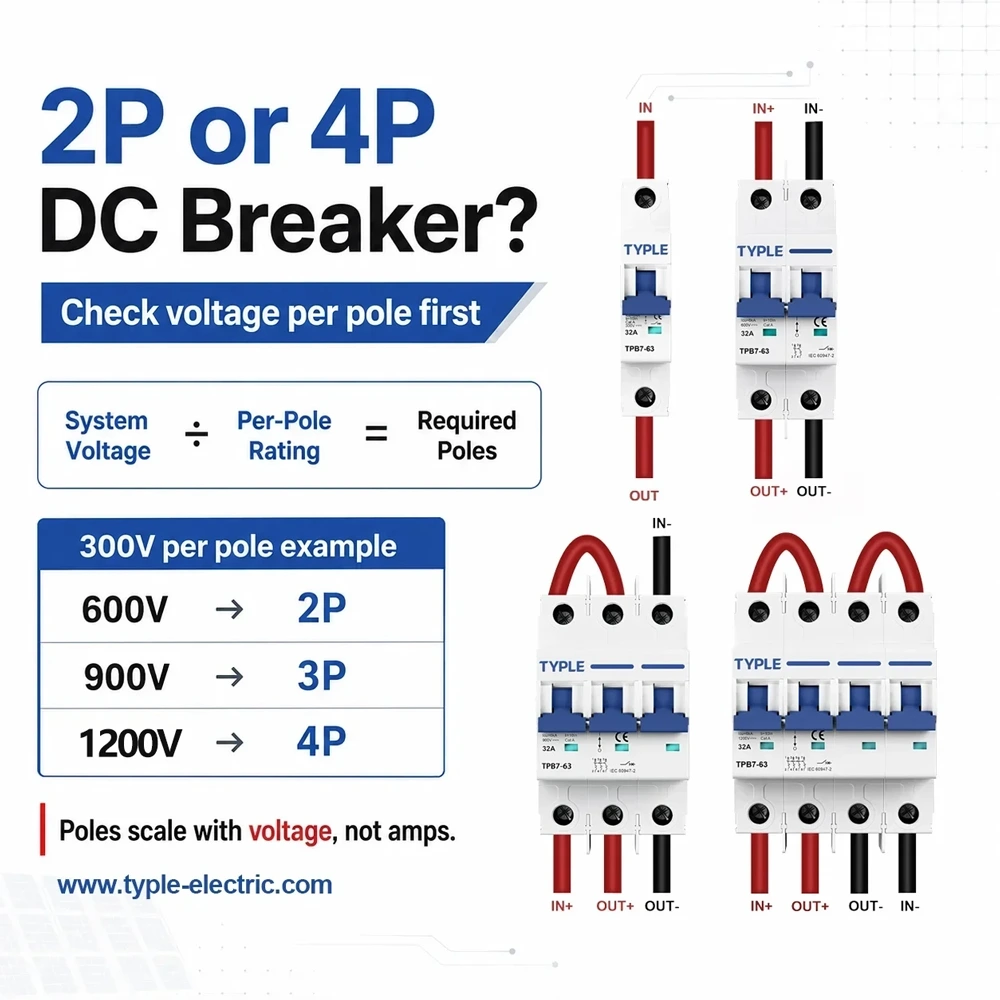
The per-pole rating is the number that actually decides pole count, and it usually has to be read from the datasheet rather than the front label. This matters even inside a single product family. Take TYPLE’s DC MCB, the TPB7-63, which comes in two variants:
| DC MCB variant | Volts per pole | 1P | 2P | 3P | 4P |
|---|---|---|---|---|---|
| TPB7-63 | 300 V | 300 V | 600 V | 900 V | 1200 V |
| TPB7-63Z | 250 V | 250 V | 500 V | 750 V | 1000 V |
Both are the same 63 A DC miniature circuit breaker, yet they need a different number of poles for the same job. For a 600 V string, a TPB7-63 needs just 2 poles, while a TPB7-63Z needs 3. If you sized from the “63 A DC MCB” label alone without checking the per-pole rating, you could fit a 2-pole device on a circuit that actually needs 3 — an under-rated breaker that may fail to clear a fault. Always read volts-per-pole, then count poles.
Pole Count by System Voltage
Divide the system voltage by the breaker’s per-pole rating and round up: a 250 V-per-pole breaker needs 2 poles at 500 V, 3 at 750 V and 4 at 1000 V; a 300 V-per-pole breaker needs 2 poles at 600 V and 4 at 1200 V; a 500 V-per-pole breaker needs 2 poles at 1000 V and 3 at 1500 V. The rule never changes — only the per-pole number does.
The table below maps common solar and battery DC system voltages to the pole count needed, across the per-pole ratings in TYPLE’s DC breaker range:
| System DC voltage | 250 V/pole (TPB7-63Z / TPM7) | 300 V/pole (TPB7-63) | 500 V/pole (TPM7n-320) | 750 V/pole (TPM7n-800) |
|---|---|---|---|---|
| 500 V | 2 poles | 2 poles | 1 pole | 1 pole |
| 600 V | 3 poles | 2 poles | 2 poles | 1 pole |
| 750 V | 3 poles | 3 poles | 2 poles | 1 pole |
| 1000 V | 4 poles | 4 poles | 2 poles | 2 poles |
| 1500 V | not suitable | not suitable | 3 poles | 2 poles |
Two things worth noting. First, at 1000 V you can protect the same circuit with 4 poles of a 250 V-per-pole breaker or just 2 poles of a 500 V-per-pole one — same voltage rating, half the poles. Second, 1500 V — the ceiling of modern utility PV — is still within the IEC low-voltage range (direct current up to 1500 V is classified as low voltage), so it is handled with low-voltage DC breakers, not high-voltage switchgear.
Poles Also Depend on the Breaker Type: DC MCB vs DC MCCB
Pole count is driven by voltage, but the breaker type sets the current range where it applies: a DC MCB protects individual strings up to about 63 A, while a DC MCCB handles combined currents from 63 A to 800 A at the combiner output or in the array cabinet. Both follow the same per-pole voltage rule.
In a typical DC1000V array, per-string protection is handled by a DC MCB such as the TPB7-63, rated up to 63 A and available in 1P to 4P. Where several strings are combined, the higher combined current is protected by a DC MCCB sized for that load. The pole-counting rule is identical for both: a 1000 V circuit still needs enough poles in series to break the arc, whether the device is a compact MCB on one string or an MCCB on the combined feed. What changes between them is current capacity and physical size, not how you count poles.
So a full DC1000V protection scheme often uses both: several 4-pole (or 2-pole, depending on variant) DC MCBs at string level, feeding a combiner box whose output is protected by a DC MCCB. Each device is sized for its own current, and each is given enough poles for the 1000 V system voltage.
Two Breakers Rated for the Same Voltage Are Not the Same
A 4-pole 250 V-per-pole breaker and a 2-pole 500 V-per-pole breaker are both rated for DC 1000 V, but they are not interchangeable: the 2-pole version takes far less panel width and uses fewer terminals. Same voltage rating, very different footprint.
This is the practical payoff of reading per-pole ratings. Take a real DC 1000 V requirement on the MCCB side:
- A 4-pole TPM7 reaches 1000 V using all four of its 250 V poles. Its 4-pole frame is 121 mm wide.
- A 2-pole TPM7n-320 reaches the same 1000 V using two 500 V poles. Its 2-pole frame is 76 mm wide.
Both are correctly rated. But the 2-pole option saves 45 mm of panel width per breaker, halves the number of terminations, and leaves more room inside the combiner box or DC cabinet. Across several breakers, that adds up fast.
There is a second difference the pole count does not show: service breaking capacity. The TPM7 has an ultimate breaking capacity (Icu) of 20 kA but a service breaking capacity (Ics) of 15 kA — after clearing a maximum fault it returns to service at 15 kA. The TPM7n has Ics equal to Icu at 20 kA, so it stays fully serviceable after a maximum-level short circuit. When comparing two breakers “rated for the same voltage,” always check per-pole rating, physical width and Ics — not just the headline voltage number.
Related reading: complete guide to solar combiner boxes · DC MCB vs DC isolator


