
A contractor on a government reconstruction project in the Middle East came to us with 2,000 outdoor DC boxes to source and one question he could not resolve. Finding suppliers who claimed IP68 was easy — almost every quotation said IP68. What he could not work out was why those quotations, for what looked like the same product, differed in price by a factor of three.
His project was specific: DC 500V, 32A, two strings in and one output, wall-mounted on residential balconies, direct sun, ambient up to 50°C. He needed genuine IP68 — the boxes really would face standing water in that environment. So the question was not whether he needed IP68. It was how to tell a real IP68 from a printed one.
The short version: an IP68 marking on its own describes almost nothing. The test conditions behind it, the configuration that was tested, the enclosure and sealing, the internal components, and the documentation all move the price — and only some of them are visible on a datasheet. This is how we walked the project team through it, and what any EPC or procurement team should verify before approving an IP68 box.

What IP65, IP67 and IP68 Actually Cover
An IP code under IEC 60529 has two digits. The first covers solid objects and dust. The second covers water. They are independent tests.
| Code | First digit — solids | Second digit — water |
|---|---|---|
| IP54 | Dust-protected (limited ingress) | Splashing water |
| IP65 | Dust-tight | Water jets (6.3 mm nozzle) |
| IP66 | Dust-tight | Powerful water jets (12.5 mm nozzle) |
| IP67 | Dust-tight | Temporary immersion, 1 m for 30 min |
| IP68 | Dust-tight | Continuous immersion,conditions agreed between manufacturer and user |
Two things fall out of this table immediately.First,IP65 through IP68 all share the same first digit. A box rated IP65 is already dust-tight — tested with talcum powder under reduced internal pressure. For a project in the Gulf, North Africa or any desert environment, that first digit is the one carrying the real load. Upgrading from IP65 to IP68 buys you nothing at all in dust performance, because there is nothing above 6. Second, look at the last row again.
Why Two “IP68” Boxes Can Differ in Price Three Times Over
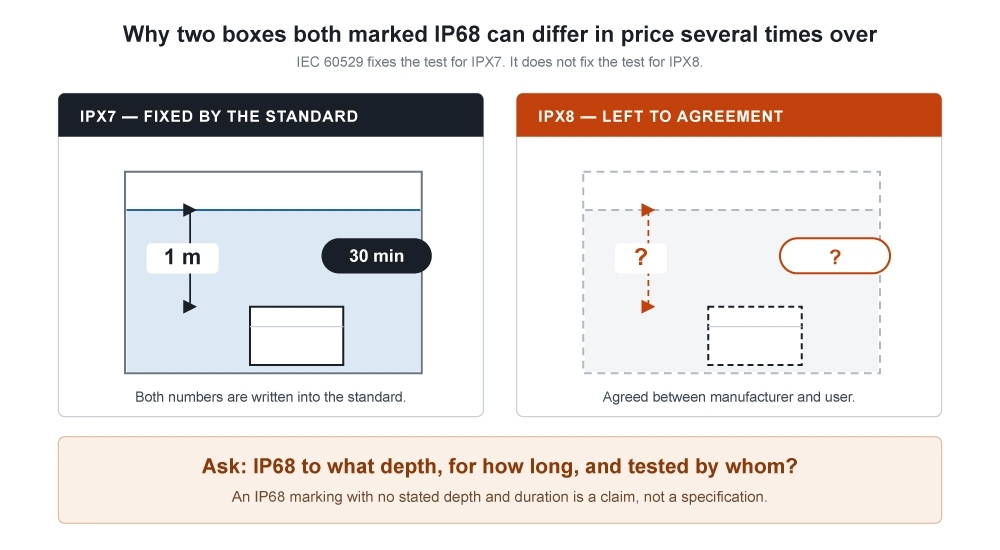
IEC 60529 specifies exact test conditions for IPX7: one metre of water, thirty minutes. For IPX8 it does not. The standard states that the test conditions are more severe than IPX7 and are to be agreed between the manufacturer and the user.
That single clause explains most of the price spread. “IP68” written alone declares no depth and no duration. One supplier may have tested to 1.2 m for 30 minutes. Another may have tested to 3 m for 24 hours, with a gasket, enclosure and cable-entry system that cost several times more. Both print the same four characters.
So the first question to a supplier is never “is it IP68?” It is:
“IP68 to what depth, for how long, tested by whom, and on which configuration?”
A supplier who has genuinely tested answers in one sentence. A supplier who has not changes the subject.
The Trap: an IP68 Shell Is Not an IP68 Product
Here is the distinction that separates a real IP68 box from a marketing one, and it is the one experienced buyers still miss.
An enclosure supplier can provide an IP68-rated empty box. The product manufacturer then drills that box, cuts cable entries, fits glands, mounts switches and terminals, and closes it. The finished product is only as watertight as its weakest interface. A perfect IP68 shell counts for nothing behind an undersized cable gland, a loose blanking plug, a pinched gasket, or inconsistent assembly torque. The rating that matters is the one for the complete, assembled, production-configured box — not the shell it started as.
This is also where immersion and jetting diverge, and it is a second trap. Under immersion, water pressure is uniform and static. Under a jet, it is concentrated and directional — it attacks seams and glands from angles that standing water never does. IEC 60529 handles this by allowing an enclosure that satisfies both to carry both codes, for example IP65/IP68. A box marked IP68 alone has, strictly read, made no claim about jet resistance — which matters, because module-washing crews in dusty regions work with pressure lances, not gentle water.
So when a quotation says IP68, the procurement question is: IP68 on what?
- The empty enclosure body only?
- The enclosure with its original cover and gasket?
- The enclosure after machining?
- The complete assembled product, with production cable entries fitted?
Only the last one describes what arrives on site. TYPLE’s IP68 rating on the TPX7-N is stated for the assembled box, not the bare shell — because that is the only figure a project can actually rely on.
When IP68 Is Genuinely Required — and When It Is Not
Over-specifying an IP rating is not a free safety margin. It raises unit cost, extends lead time, narrows your supplier pool, and — as the next section covers — works against thermal management.
| Installation condition | Practical rating |
|---|---|
| Rooftop C&I, wall or rail mounted | IP65 |
| Carport, pole or frame mounted, exposed | IP65 / IP66 |
| Regular high-pressure module washing | IP66 |
| Ground-level in flood-prone or monsoon terrain | IP67 or IP65/IP68 |
| Agricultural and irrigation sites, standing water | IP65/IP68 |
| Coastal low-lying, storm surge exposure | IP65/IP68 |
| Buried, vault, or below-grade enclosures | IP68, with stated depth and duration |
The pattern is straightforward. If the box can be submerged — because it sits low, in a flood plain, or in a pit — immersion rating is a real requirement. If it is mounted at chest height on a structure, it will never be submerged, and the money is better spent on the gaskets, glands, ambient temperature rating and internal protection components.
Where the Rest of the Price Difference Sits
Beyond the test itself, several physical differences move the price. For a 2,000-unit government batch, each of these is worth asking about.
Cable glands and entries. The most common ingress point. Gland material, temperature range, compatible cable diameter, thread and sealing method, tightening torque, and how unused entries are sealed all vary — and the IP figure printed on a gland only applies if it is installed correctly.
Gasket and closure. The gasket must hold sufficient, reasonably uniform compression around the whole opening. Material, profile, number of closure points, and assembly consistency all differ between a cheap box and a durable one. At a 50°C site, the gasket also has to survive years of heat, UV and dust without hardening.
Enclosure material and outdoor durability. An IP rating says nothing about UV resistance, flammability, impact resistance, or dimensional stability at high temperature. An outdoor enclosure in the Gulf needs evidence on those separately from its IP code.
Internal DC components. Two boxes with identical exteriors can hold very different components. The DC circuit breaker, isolator, SPD, terminals and busbars vary in voltage rating, breaking capacity, temperature performance and service life. A meaningful comparison is between complete bills of materials — not between enclosure sizes and IP labels.
Production consistency. For 2,000 units, the performance of one laboratory sample matters far less than whether unit 1,847 is built the same way. Controlled hole dimensions, torque control, gasket inspection, dielectric testing and batch traceability are what make a rating repeatable across a batch — and they cost money that a bare-minimum supplier saves.
Documentation and engineering support. A GA drawing, schematic, BOM, cable schedule, test report and inspection plan are part of what a project buys. They cut review time and let the EPC confirm that the manufactured product matches the approved design.
For a government project, the lowest unit price is rarely the lowest project cost. An enclosure that fails in the field means drawing revisions, replacements, site delays, and disputes over whether what was delivered matches what was approved.
The Second Question: Will a Sealed Box Overheat at 50°C?
The contractor’s second question was the better one, because the boxes would sit outdoors on balconies in direct sun: how do you stop a sealed IP68 box from overheating?
That question deserves the honest engineering answer, not a marketing one.
A sealed enclosure cannot ventilate. Heat generated inside leaves only by conduction through the walls and radiation from the surface — there is no convective path out, and the higher the IP rating, the more completely that is true. So the design cannot assume airflow will carry heat away.
In Middle East conditions, though, the internal component losses are usually not the dominant heat source. A 32A DC box dissipates a modest amount across its breaker, terminals and busbar. What actually drives internal temperature up is solar irradiance landing on the enclosure surface, on top of ambient air that may already be at 50°C. That points to where the largest gains sit — and the single most effective one is not a feature of the box at all.
Keeping direct sun off the enclosure surface does more than any material choice. Shading the box — with an external canopy, or by mounting it where the structure already blocks midday sun — removes the dominant heat input at its source, and it costs a fraction of anything done to the enclosure itself. This is an installation measure rather than a box function, and we raise it with customers at the drawing stage precisely because it is the highest-leverage step available on a sealed enclosure in a hot climate. Alongside it, two box-level factors help at the margin: a light-coloured non-metallic enclosure absorbs less solar radiation than dark painted steel, and the internal components should be derated against the real internal temperature at 50°C ambient, not against 25°C.
There is a further point specific to sealed boxes in desert climates: condensation. Large day-to-night temperature swings cause trapped moisture to condense inside, and a fully sealed box does not breathe it out. It is a fair question to put to any supplier proposing a high IP rating — how the design equalizes pressure and handles internal moisture.
What we did not do was claim the thermal question was “solved” by a number. The internal temperature of a specific box under direct sun depends on the final BOM, component spacing, mounting clearance, enclosure colour and the solar-load assumption — and it is confirmed by a project-specific temperature-rise review, not asserted in a brochure. For this project that review belongs in the drawing stage, and we told the customer exactly that rather than promising a figure we had not measured.
How We Supported the Technical Review
The discussion did not start with a claim that our box was “better.” It started with the site conditions and the buyer’s own questions.
We ran a video call and worked through IEC 60529 directly — the two digits, what IPX8 leaves open to agreement, and why dual marking exists. The aim was not to push the highest number; it was to pin down what exposure the project actually faced and what evidence would support the specification.
We then broke the quotation into parts that could be examined side by side: enclosure and sealing, cable entries, internal DC components, material and environmental performance, test evidence, production controls, and project documentation. That let the buyer compare technical scope, not just the word “IP68” against a unit price.
For the thermal concern, we treated the enclosure, internal losses, component ratings, mounting method and solar exposure as one system, set out which measures the design and installation could use, and named shading as the highest-leverage step — rather than asserting the problem away with a temperature figure we had not measured. The proposed solution — a DC 500V, 32A, two-in-one-out TPX7-N — is now in the customer’s drawing-review stage. It has not been installed or field-proven yet, and this article makes no claim that it has.
Trust in this business is not built by asserting good quality. It is built in the answer given to each specific question behind it.
IP68 Procurement Checklist for EPCs and Project Owners
Before approving an IP68 DC box, ask the supplier for these. It doubles as a document request list for a tender file.
IP test report — exact tested model; laboratory and report number; test date; water depth and duration; the sample configuration that was tested; pass criteria; and evidence that the quoted product matches the tested one.
Enclosure and entries — enclosure material and dimensions; UV and flammability data; impact rating; gasket material and temperature range; cable-gland models and cable range; blanking-plug specification; required tightening torque.
Electrical design — complete BOM; DC voltage and current ratings; breaking capacity; SPD parameters if included; conductor cross-section; terminal and busbar ratings; grounding method; applicable IEC standards.
Thermal suitability — maximum ambient temperature; direct-sun exposure; internal power loss; component derating; maximum internal temperature; and the calculation or test behind it.
Production and delivery — approved drawing revision; sample-approval process; inspection and test plan; batch traceability; packaging and labelling; lead time; spares and warranty.
A Note on What to Call This Box
Commercially, a two-string-in, one-output unit is sold as a “combiner box,” and that is the term buyers search for. Technically it is a genuine combiner — it does combine two PV strings into one output — so the name fits. (A one-in, one-output unit is a different case: it does not combine anything, and “PV DC protection box” is the more accurate description for that configuration, even though it is often sold under the combiner-box label too.) The distinction matters when you compare quotations: make sure two “combiner boxes” you are pricing actually have the same input and output count before you compare anything else.
How to Verify an IP Claim Before You Order
A six-point checklist you can send to any supplier:
- Ask for the test report, not the datasheet. A datasheet is a claim. A report is evidence.
- For IP68, ask for depth and duration. Without both numbers the rating is not a specification.
- Check for dual marking. If you need jet resistance and immersion resistance, the marking should read IP65/IP68 or IP66/IP68, not IP68 alone.
- Ask what was tested. The rating applies to the complete assembly as installed. An IP68 shell fitted with IP65 cable glands is an IP65 assembly. Unused knockouts and over-tightened glands both void the rating in the field.
- Ask for the ambient temperature range alongside the IP code. The two are not related, and only one of them appears in most marketing material.
- Ask what the enclosure material and finish are, and how the design handles condensation.
TYPLE’s Enclosure Options
TYPLE builds PV combiner boxes across both enclosure platforms, so the recommendation is not tied to what we happen to stock:
- TPX7-M — metal enclosure, IP65, for rooftop and C&I installations where mechanical robustness is the priority. See our metal-enclosure DC1000V combiner box
- TPX7-P — non-metallic enclosure, IP65, for residential and light commercial arrays.
- TPX7-N — non-metallic enclosure, IP68, our sealed platform for sites where the box can genuinely be submerged rather than jetted. Ingress protection degree and test parameters are confirmed against the order specification.
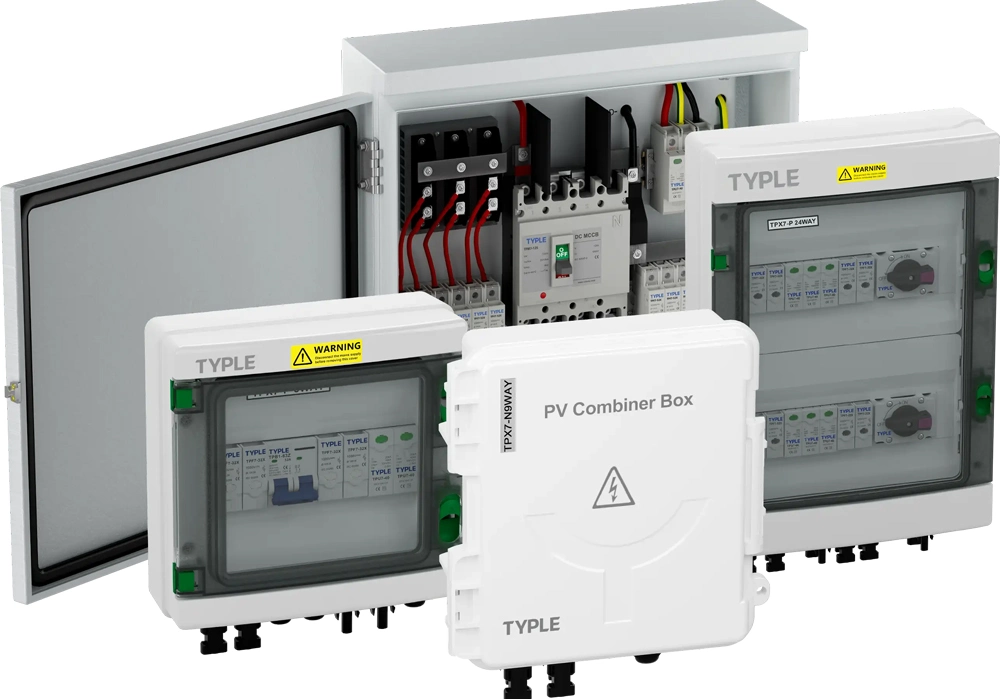
All enclosures are engineered to align with IEC 61439, with an ingress protection degree declared per IEC 60529. Internal protection components are designed to IEC 60947-2 (DC MCB and DC MCCB), IEC 61643-31 (DC SPD), IEC 60269-6 (fuse-links) and IEC 60947-3 (fuse-combination units), and are built with components sourced from certified supply chain partners. If you are unsure which rating your site actually requires, send us the mounting height, washing regime and site conditions — our engineering team will tell you where the rating boundary sits, including when a lower rating is the correct answer. For the full picture of enclosure construction and internal layout, see what is inside a solar combiner box, or browse the complete PV combiner box range. Ratings are not the only specification that gets misread from a headline number — the same applies to the per-pole voltage rating of DC circuit breakers.
Need a Project-Specific Drawing?
If you are selecting an outdoor PV DC combiner box for a Middle East project, send us your single-line diagram, maximum DC voltage and current, input/output count, ambient temperature, exposure conditions, required IP rating, and any preferred component brands. Our engineering team will review the specification and prepare a project-specific drawing and BOM for technical evaluation — with a reply within 24 hours.


