

A solar combiner box for an off-grid system brings multiple photovoltaic (PV) strings together before they feed a charge controller or an inverter with an integrated solar charge controller. It can also provide string-level overcurrent protection, surge protection and a means of isolating the PV array, depending on its design. To select one, match its voltage, string count and current ratings to the array and the downstream controller or inverter. The box does not connect or protect the battery bank; that requires appropriately rated equipment on the battery circuit.
Off-Grid PV System Layout
A typical system with a separate MPPT charge controller follows this path:
PV modules → PV strings → combiner box → MPPT charge controller → battery bank → inverter → AC loads
A hybrid inverter or off-grid inverter-charger may include an MPPT controller. In that case, the combiner output usually feeds the inverter’s PV input directly, subject to the inverter’s input specifications. The battery connects to the inverter through a separate DC circuit with its own conductors and protection.
Not every off-grid array needs a combiner box. If an inverter or charge controller has enough independent PV inputs for the planned strings, and the design does not require external string protection or consolidation, the strings may connect directly as permitted by the equipment instructions and local electrical rules. A combiner is useful when several strings need to share an output cable or when the design calls for centralized fusing, surge protection or isolation.
Combiner Box Functions and Limits
A combiner connects PV strings in parallel. Parallel connection increases the combined current while leaving the voltage close to that of one string. The number of modules connected in series within each string sets string voltage. This distinction matters when checking both the combiner’s ratings and the controller’s input limits.
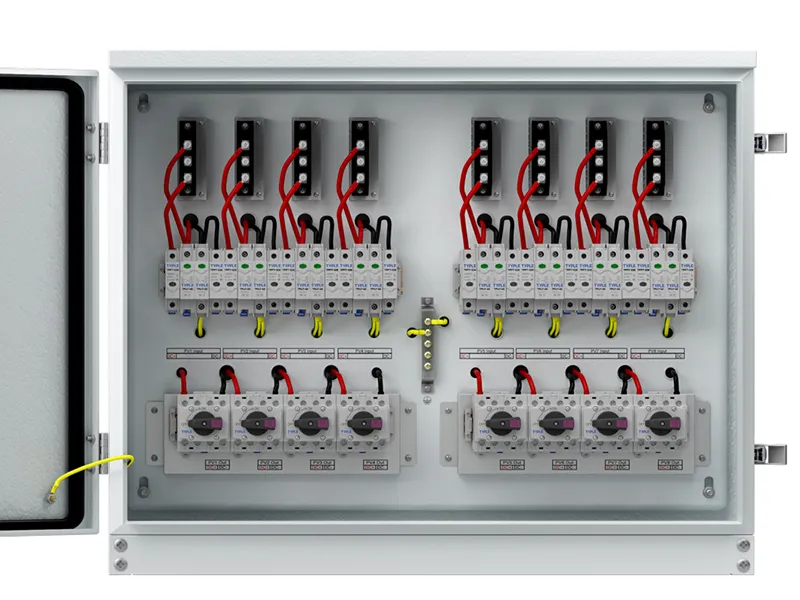
Depending on the model and project design, the box may include:
- String fuses: Protect individual string circuits against specified overcurrent conditions. A fuse must be selected for the module, conductor and system design; do not substitute a larger fuse simply because the installed fuse has opened.
- Surge protective device (SPD): Limits transient overvoltage exposure when selected and installed to suit the PV system and site. Its voltage rating and protection arrangement must be compatible with the array.
- DC disconnect or breaker: Allows the PV circuit to be isolated when the equipment is rated for the application and installed according to its instructions.
These components are not interchangeable by default. A breaker is not automatically an acceptable substitute for a fuse, and a disconnect’s presence does not mean every circuit in the system is isolated.
When an Off-Grid System Needs a Combiner
Consider a combiner when there are multiple parallel strings, a long cable run to the controller or inverter, or a need to house array-side protection in one accessible enclosure. It can simplify cable routing and make string circuits easier to identify during maintenance.
A combiner may be unnecessary or unsuitable when there is only one string, the controller or inverter is designed to accept the strings independently, or its input configuration already provides the required protection. Some charge controllers also accept only specific string arrangements. Check the equipment manual before combining strings: the summed current must remain within the PV input limit, and parallel strings generally need compatible electrical characteristics.
The box does not increase the PV array’s power, regulate charging, manage batteries or convert DC to AC. Those functions belong to the controller, battery system and inverter.
Electrical Ratings and Component Selection
Start with the PV module and system design documentation, then verify the following ratings.
Maximum DC voltage: Calculate the array’s maximum open-circuit voltage using the module data and the design temperature conditions. Cold temperatures can raise module voltage. The combiner, disconnect, fuses, SPD and other connected components must be suitable for the resulting system voltage. The charge controller or inverter may have a lower maximum PV input voltage than the combiner, so both limits matter.
Number of inputs and outputs: Choose enough string inputs for the design and confirm the output arrangement matches the downstream equipment. “Four in, one out” describes a configuration, not the voltage or current capacity of the box.
Current and overcurrent protection: Determine the maximum circuit current from the module specifications and applicable design rules. Check the current ratings of string fuses, fuse holders, busbars, output terminals, conductors and disconnect. Do not size components by simply adding the module’s nominal operating current; follow the design method required by the applicable electrical code and equipment documentation.
Controller or inverter compatibility: Confirm the combined array current, maximum PV voltage and short-circuit current remain within the controller or inverter’s specified input limits. If it has multiple MPPT inputs, each input may have separate limits and may require strings to be grouped in a particular way. A combiner cannot compensate for an undersized controller.
Enclosure and environmental rating: Select an enclosure suitable for its location, including exposure to rain, dust, direct sun, heat, humidity and corrosion. The stated enclosure rating depends on correct installation, cable glands, covers and orientation. A rating on the nameplate does not protect a box if openings are left unsealed or it is mounted contrary to the manufacturer’s instructions.
For projects in markets with specific certification or listing requirements, verify that the complete product and its components are approved for the intended use. UL Solutions, for example, identifies UL 1741 as a standard for combiner boxes; the required approval depends on the project jurisdiction and authority having jurisdiction.
Placement, Wiring, and Installation Considerations
Install the combiner where string conductors can reach it without excessive or poorly supported cable runs, while leaving access for inspection and service. Follow the manufacturer’s mounting orientation, clearance, conductor-entry and environmental instructions. Avoid locations that are prone to flooding, mechanical impact or unnecessary heat exposure.
Use conductors, connectors and glands that are rated for the PV voltage, current, temperature and outdoor conditions. Keep string polarity and circuit identification clear. Confirm grounding and bonding arrangements against the project drawings and local rules; the combiner enclosure and equipment grounding conductor must be treated as part of the overall system design.
The array can remain energized in daylight even when downstream equipment is switched off. Installation and service therefore require procedures appropriate to PV DC equipment. A qualified installer should identify all sources, follow the equipment shutdown sequence, verify absence of voltage where required, and use the correct tools and protective equipment. Do not rely on a single switch as proof that every conductor is de-energized.
Commissioning and Common Design Errors
Before energizing the array, compare the installed equipment with the approved design and manufacturer instructions. Verify string labels and polarity, conductor terminations, fuse types and ratings, SPD status indicators, grounding and enclosure sealing. Confirm measured string voltages are consistent with the design and that the inverter or controller reports expected PV input conditions.
Frequent design errors include combining strings that should remain on separate MPPT inputs, exceeding the controller’s PV current limit, selecting a box rated for lower voltage than the cold-corrected array voltage, and confusing PV-side protection with battery-side protection. Another common problem is assuming that all combiner boxes include the same components. Review the specific product’s wiring diagram and bill of materials rather than relying on the product category name.
Conclusion
A combiner box can make an off-grid PV array easier to cable, isolate and maintain, but it must fit the array and downstream equipment. Check string configuration, cold-weather voltage, combined current, protective-device ratings, enclosure conditions and applicable approvals. Then confirm that the battery circuit is designed and protected separately.
FAQs
Can I connect a solar combiner box directly to a battery?
No. A PV combiner consolidates array circuits; it does not regulate battery charging. The PV output must feed a compatible charge controller or inverter with a suitable PV charging input. The battery connects through its own correctly designed circuit.
Does every off-grid solar system need a combiner box?
No. A single-string array or equipment with suitable independent PV inputs may not require an external combiner. The system design, equipment instructions and applicable electrical rules determine whether one is needed.
Can one combiner box feed multiple charge controllers?
Only when the system is specifically designed for that arrangement and the conductors, protection and controller inputs are compatible. Do not split a combined output casually; each controller must receive an allowed PV configuration, and the design must address current sharing and isolation.
Is a PV combiner box the same as a battery combiner?
No. A PV combiner handles solar array string circuits. A battery combiner or distribution assembly handles battery circuits and must be rated for their much different current and fault conditions.


