Moving a solar plant from 1000V to 1500V DC does not shrink its surge problem — it grows it. Longer strings and bigger arrays put more cable in the field, and more cable means more energy a lightning transient can couple onto the DC side. The components sitting at the end of that wiring — inverters, optimizers, combiner electronics — are also the most expensive things to replace. So a properly rated Type II DC surge protective device (DC SPD) on the DC side has stopped being an optional line item. On a 1500V design, it is part of getting the basics right.
If you specify, distribute, or install solar gear, here is what actually changed when the industry went to 1500V, and what it means for the DC SPDs you put on the bill of materials.

Why solar moved to 1500V in the first place
The shift wasn’t about safety — it was about cost per watt. At a higher system voltage you can wire more panels in series before hitting the string limit, so each string runs longer. Technical comparisons of 1000V and 1500V arrays show that longer strings cut the number of combiner boxes and the amount of DC cabling a project needs.[1] That trims hardware, terminations, and labor, which pulls down cost per watt. It’s a big reason utility-scale solar — the segment driving most of solar’s record-setting capacity growth worldwide — has moved to higher-voltage architecture.[2]
The catch is that the same design choices that lower cost also change the electrical environment on the DC side.
What 1500V actually changes for surge exposure
Three things move in the wrong direction at once.
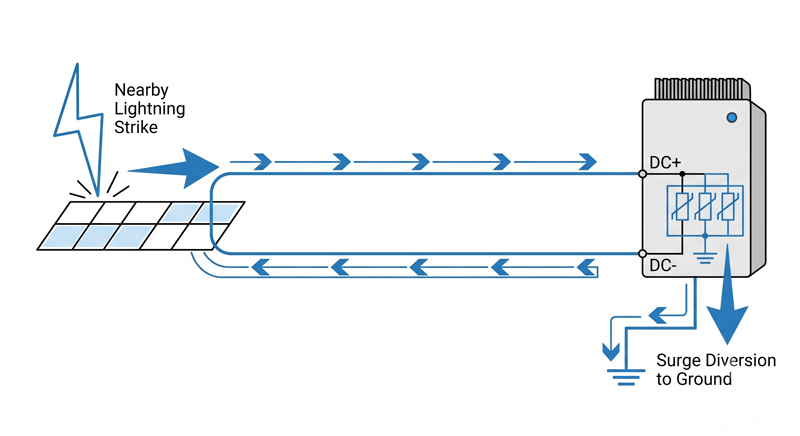
More cable in the loop. A PV array is a large conductor loop sitting outdoors. When lightning strikes nearby, it induces a transient voltage and current into that loop — and the longer the cable runs and the bigger the enclosed area, the more energy gets induced.[3] Longer 1500V strings mean larger loops, so the induced surges are bigger before anything even gets connected to a breaker.
Higher steady-state voltage to ride out. A DC SPD has to sit across a live 1500V bus without conducting under normal conditions, then clamp hard when a transient arrives. That puts a real floor on the device’s maximum continuous operating voltage (Uc) and its rated working voltage (Ue). A part rated for a 1000V system is simply the wrong tool on a 1500V string, no matter how good its surge rating looks on paper.
More valuable equipment downstream. String inverters and combiner electronics on a 1500V plant aggregate more power per unit. One transient that gets through can take out more capacity at once.
This is exactly the gap the IEC wrote a standard to close. IEC 61643-31:2018 governs SPDs for the DC side of photovoltaic installations rated up to 1500V DC — it sets the performance, safety, and test requirements specifically for PV DC SPDs, rather than the general low-voltage SPD rules.[4] If a DC SPD on a 1500V project isn’t built and tested to that part of the standard, you’re guessing.
Where plants actually lose money: the inverter
The SPD is one of the cheapest parts in the DC string. The math that justifies it isn’t the price of the device — it’s what fails when it’s missing, and how often.
Start with where plants actually lose energy. An NREL data survey found inverters behind roughly 43% of PV maintenance calls and about 35% of measured yield losses, while modules accounted for only around 2% and 1%.[5] A separate analysis by risk-data firm kWh Analytics attributed close to 80% of solar plant downtime to failing inverters.[6] The inverter is both the most failure-prone link in the chain and the one where lost generation hurts most.
It’s also the part with the shortest service life. Modules are built to run 25 years and more, and routinely do; inverters are widely recognized as the reliability weak point of PV systems and generally need at least one repair or replacement over that span.[7] Transient surges from lightning and switching are one of the recognized stressors acting on exactly this component — which is why the IEC maintains a PV-specific DC SPD standard (IEC 61643-31) alongside its lightning-protection framework (IEC 62305).[4][8] Spending a little to take one stressor off the part that already drives most of your downtime is straightforward risk math.
What “rated correctly” means when you select a DC SPD
For a 1500V design, a DC SPD is the right one only if the core ratings line up with the string. The parameters that matter:
- Rated working voltage (Ue): must cover the system’s maximum DC voltage. For a 1500V string, that means a part rated to 1500V DC — not 1000V “with margin.”
- Voltage protection level (Up): the let-through voltage during a surge. It has to stay below what the inverter’s DC input can tolerate, or the SPD passes the device’s audit but not the job.
- Nominal / maximum discharge current (In / Imax, 8/20µs): the surge energy the device can handle. A common, robust spec for the PV DC side is In 20 kA and Imax 40 kA.
- SPD type: Type II is the standard choice on the DC side of most installations. Type I is added where there’s a structural lightning protection system (LPS) or direct-strike risk — that’s an IEC 62305 lightning-protection decision, made per site.[8]
- Standard: look for compliance with IEC 61643-31 specifically, since that’s the PV-DC part of the family.
- Pole configuration: 2P and 3P versions exist for different DC+ / DC− / earth wiring schemes. Match it to how the string and grounding are actually run.
One field detail that gets missed: keep the SPD’s connecting leads short. Any extra length in the conductors to the SPD adds an inductive voltage drop that effectively raises the protection level the equipment sees, weakening the protection you paid for.[3] Tidy, short connections aren’t cosmetic — they’re part of the rating working as advertised.
A quick selection checklist for 1500V DC SPDs
| Parameter | What to confirm | Typical 1500V PV value |
|---|---|---|
| Rated working voltage (Ue) | ≥ system max DC voltage | up to 1500V DC |
| SPD type | DC side default | Type II (Type I if LPS present) |
| Voltage protection level (Up) | Below inverter DC input tolerance | low Up across the rating range |
| Nominal discharge current (In) | 8/20µs | 20 kA |
| Max discharge current (Imax) | 8/20µs | 40 kA |
| Standard | PV-DC specific | IEC 61643-31 |
| Poles | Matches wiring scheme | 2P or 3P |
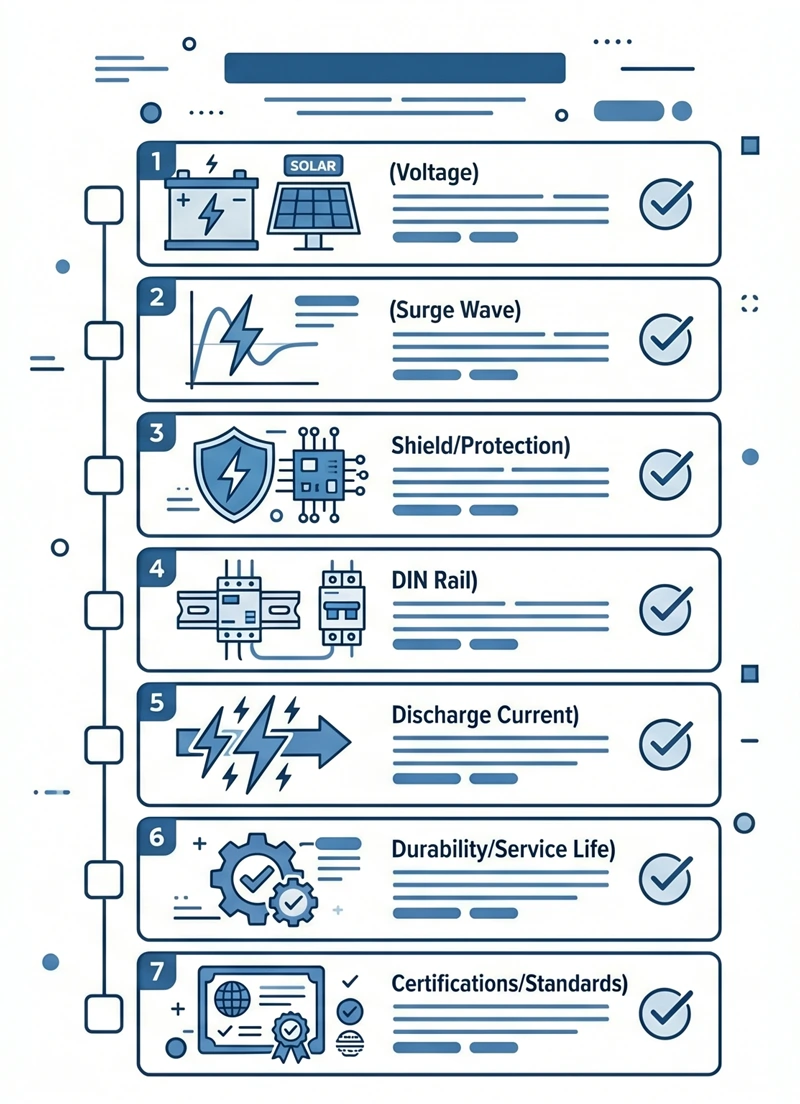
If you’re sourcing DC SPDs for 1500V projects, those seven lines are the difference between a part that protects the plant and a part that just looks compliant. TYPLE’s TPU7-40 is a Type II DC SPD covering the 500V to 1500V DC range, available in 2P and 3P with In 20 kA / Imax 40 kA — configured to the array voltage rather than supplied as a one-size default.See the full specs and wiring diagrams on the TPU7-40 product page, or talk to us about volume and OEM requirements.
FAQ
Do I need a DC SPD on a 1500V system if the inverter already has surge protection inside?
The inverter’s internal protection is sized to protect the inverter, not the string, and it isn’t a substitute for an external, replaceable, correctly rated DC SPD. External SPDs also let you swap a sacrificed device without touching the inverter.
Type I or Type II on the DC side?
Type II is the standard choice for most PV DC sides. Add Type I where the site has a structural lightning protection system or a direct-strike exposure — that call is made under IEC 62305 for the specific installation.[8]
Can I use a 1000V DC SPD on a 1500V string “with margin”?
No. The rated working voltage has to cover the system’s maximum DC voltage. A 1000V-rated part on a 1500V bus is operating outside its design and can fail.
Sources / References
- IEEE — Comparison of PV systems with maximum DC voltage 1000V and 1500V, IEEE Xplore (higher system voltage enables longer strings, reducing DC cabling and the number of combiner boxes). ieeexplore.ieee.org
- Lawrence Berkeley National Laboratory (Berkeley Lab) — Utility-Scale Solar, 2025 Edition (utility-scale PV is the dominant form of new US solar capacity). emp.lbl.gov
- IAEI Magazine (International Association of Electrical Inspectors) — Surge Protection for Photovoltaic Systems (induced transients scale with cable length and loop area; connecting-lead inductance reduces SPD effectiveness). iaeimagazine.org
- IEC — IEC 61643-31:2018, Low-voltage surge protective devices – Part 31: SPDs for photovoltaic installations (covers the DC side of PV installations up to 1500V DC). webstore.iec.ch
- NREL (U.S. National Renewable Energy Laboratory), 2020 PV reliability data survey — inverters linked to ~43% of maintenance calls and ~35% of measured yield losses; modules ~2% / ~1% (reported by pv magazine). pv-magazine.com
- kWh Analytics — solar plant reliability analysis: roughly 80% of solar plant downtime attributed to failing inverters (reported by pv magazine USA). pv-magazine-usa.com
- NREL — Photovoltaic Inverter Reliability Assessment and NREL field degradation studies (modules run 25+ years; inverters typically need replacement within plant life; power electronics ~8–12% of lifetime PV cost). research-hub.nrel.gov
- IEC — IEC 62305 series, Protection against lightning (framework for lightning protection systems and SPD coordination). webstore.iec.ch