

Across 2024 and 2025 the IEC 61643 family of surge protection standards moved through a coordinated revision. The base document IEC 61643-01 was reissued in 2024. IEC 61643-11, which covers surge protective devices for AC low-voltage distribution, was published as a 2025 edition in June 2025. IEC 61643-31, the part that governs surge protective devices on the DC side of photovoltaic installations rated up to 1500 V DC, is progressing through the European route as prEN IEC 61643-31:2025.
For distributors, EPC contractors, and installers specifying a PV combiner box, the practical effect is narrow but real. The reference standard printed on a DC surge protective device datasheet, and the rated parameters behind it, are the items that buyers, inspectors, and insurers now check more closely.
Which standard applies to the DC side of a PV system
IEC 61643-31 is the part that applies to surge protective devices connected to the DC side of PV generators and inverters, rated up to 1500 V DC. It is a separate document from IEC 61643-11, which covers AC low-voltage distribution. The two are not interchangeable, and a device marked only to IEC 61643-11 is not qualified for DC-side PV use.
The scope of IEC 61643-31 covers devices that contain at least one non-linear component and are intended to limit surge voltages and divert surge currents from lightning or switching events. The standard applies to permanently connected devices where connection and disconnection require a tool. Portable devices and two-port devices with internal series impedance are outside its scope. Devices for PV systems with energy storage such as batteries are also outside its scope.
Two adjacent standards complete the picture. IEC 60364-7-712 covers the design and installation of electrical components in PV systems, including grounding and surge mitigation. UL 1449 is the North American equivalent for surge protective device performance and safety.
What the 2025 revision cycle covers
The 2024 and 2025 editions tighten test methods so that they reflect real surge conditions more closely, including direct lightning strikes and switching surges, and they clarify the coordination between devices on the DC side and devices on the AC side of the power conversion equipment. IEC 61643-01:2024 sits underneath the application parts as the document that establishes the fundamental requirements. IEC 61643-11:2025 builds on that base for the AC side. The prEN IEC 61643-31:2025 work brings the PV DC-side requirements into the same updated framework.
For a buyer, the takeaway is not that existing stock is suddenly non-compliant. Standard revisions generally apply to new type testing going forward. The takeaway is that the edition reference and the test data behind a datasheet are now a more frequent point of verification in tenders and insurance reviews.
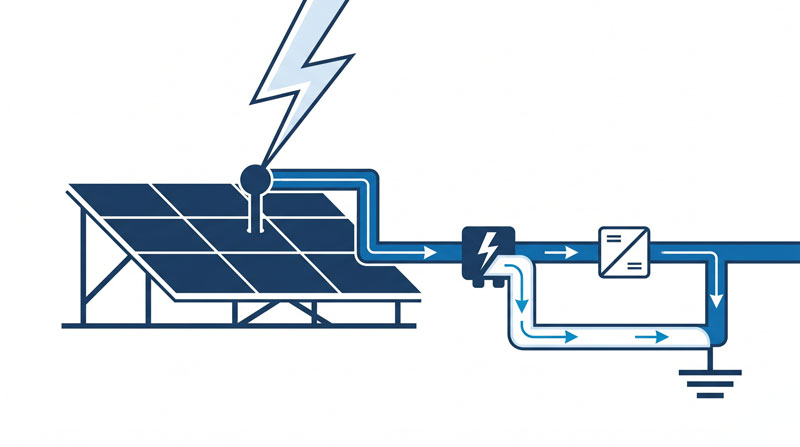
The parameters a DC surge protective device datasheet should state
A datasheet for a DC surge protective device should let an engineer verify suitability without a follow-up call. For the TYPLE TPU7-40 DC surge protective device, the stated values are:
| Parameter | Value |
|---|---|
| Rated working voltage Ue (DC) | 500 / 600 / 1000 / 1500 V |
| Test class | Class II |
| Nominal discharge current In (8/20 µs) | 20 kA |
| Maximum discharge current Imax (8/20 µs) | 40 kA |
| Voltage protection level Up | 2.2 / 3.6 / 5.3 kV |
| Poles | 2P / 3P |
| Reference standard | IEC 61643-31 |
| Operating temperature | -30 °C to +70 °C |
| Mounting | 35 mm DIN rail |
The two checks that decide suitability are the rated working voltage against the array open-circuit voltage, and the voltage protection level Up against the withstand voltage of the equipment being protected. A 1500 V array requires a device rated for the 1500 V band, not a 1000 V device operated near its limit.
How this maps to PV combiner box selection
The combiner box is where the DC surge protective device physically sits. In a TPX7-P series PV combiner box for residential and small commercial rooftops, or a TPX7-M series 1000 V combiner box for larger arrays, the surge protective device is wired in parallel across the common positive bus, the common negative bus, and the PE ground.
Three checks matter when matching the box to the project:
- The DC surge protective device voltage rating falls in the same band as the array open-circuit voltage.
- The enclosure rating suits the site. TYPLE TPX7 combiner box housings are rated IP65 with IK10 impact resistance for outdoor and exposed installations.
- The internal wiring and grounding consolidate to a single reliable PE point, which is what makes the surge path effective. A surge protective device with no clean ground reference does not protect anything.
Because the combiner box, the DC surge protective device, the DC isolator, and the fuse are selected together, a combiner box supplied pre-wired to the project specification removes the most common source of field error.
Why the reference standard matters for export markets
In CE markets across Europe, the prEN route means the IEC text is adopted as an EN edition, so buyers expect datasheet references aligned to the EN version and verify device markings against the documentation. Installations in Australia follow AS/NZS rules for PV array installation that reference the same protection principles. In Southeast Asian markets such as Vietnam, Thailand, and the Philippines, projects commonly reference IEC directly.
The common factor is that the standard reference on the datasheet has to match the marking on the device, and the supporting certificate has to be verifiable. The TYPLE TPU7-40 DC surge protective device is designed and tested to IEC 61643-31. TYPLE TPX7 combiner boxes are engineered to align with IEC 61439, and the protection components inside are designed to IEC 60947-2, IEC 61643-31, and IEC 60269-6. Supporting certificates for these components are available through TYPLE’s qualified partner suppliers and can be verified against the issuing bodies before purchase. Buyers who request certificates can verify them against the issuing bodies before purchase.


