
By Chris Huang, Product & Sourcing Manager · Technically reviewed by TYPLE Engineering Team
A solar combiner box consolidates the DC output of multiple PV strings into a single output, while housing protection devices — string fuses, a surge protective device (SPD), and a DC circuit breaker or isolator — in one weatherproof enclosure. It sits between the solar array and the inverter, simplifying wiring and centralizing string-level protection. This guide explains what a combiner box does, what’s inside it, how it differs from a junction box, and how to choose and size one for your PV system. It is written for EPC contractors, distributors, and installers specifying combiner boxes for residential, commercial, and off-grid projects.

What is a solar combiner box?
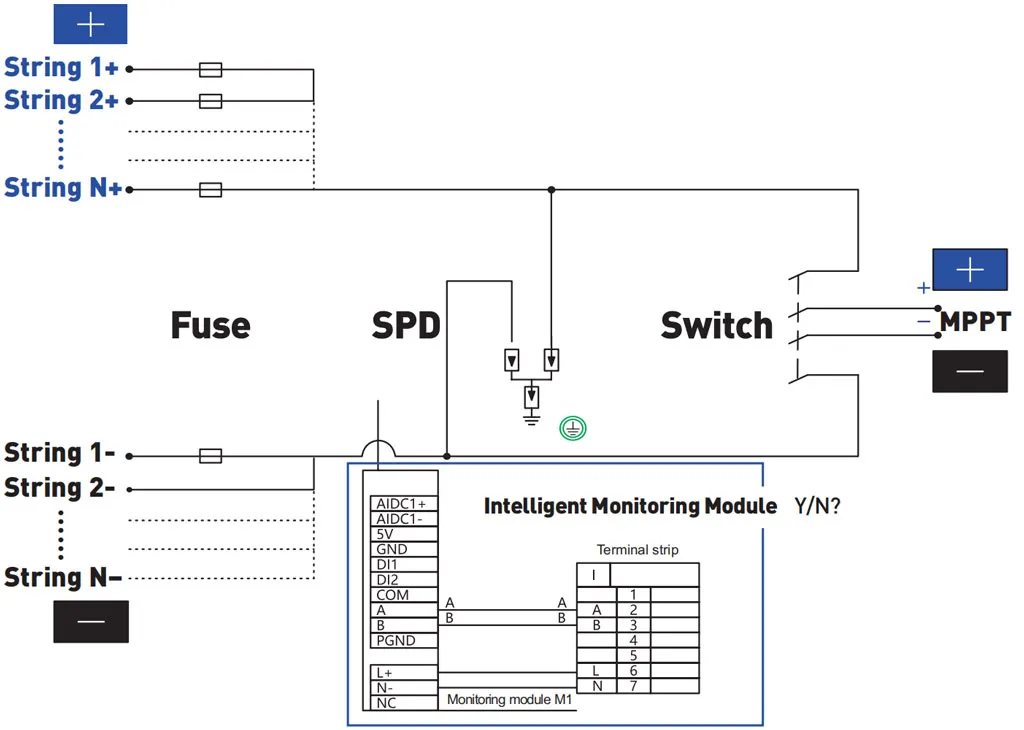
A solar combiner box — also called a PV combiner box, solar power combiner box, or solar panel combiner — is an enclosure that connects several PV strings in parallel, merging their DC outputs into one set of conductors that runs to the inverter or charge controller.. Inside, each string passes through its own fuse, and the combined output is protected by a surge protective device and a DC breaker or isolating switch. In a typical system, instead of running many separate string cables all the way to the inverter, the strings terminate at the combiner box, are protected and combined there, and a single larger cable carries the consolidated current onward. This reduces cabling, centralizes protection, and makes maintenance and fault isolation easier. Combiner boxes are rated by the maximum DC system voltage they handle — commonly DC600V, DC1000V, or DC1500V — and by the number of string inputs and outputs, written as “inputs in / outputs out” (for example, 4 in / 1 out, or 6 in / 1 out).
What does a solar combiner box do?
A solar combiner box performs four functions: it combines multiple PV string outputs into one, protects each string with an individual fuse, protects the combined circuit against surges and overcurrent, and provides a means of safely disconnecting the array. Together these turn many vulnerable individual string runs into one protected, manageable DC circuit. The four roles in detail:
- Combining
— parallel-connects string outputs into a single higher-current output - String protection
— a per-string fuse isolates a faulty or reverse-current string without taking down the array - Surge protection
— a Type 2 (or Type 1+2) SPD diverts lightning-induced and switching surges away from the inverter - Disconnection and overcurrent
— a DC isolator and/or DC circuit breaker allows safe shutdown and protects the combined circuit
Does a solar combiner box increase the voltage?
No. A solar combiner box does not increase voltage. It connects strings in parallel, which combines current while the voltage stays the same as a single string. System voltage is determined by how many modules are wired in series within each string, not by the combiner box. This is a common misunderstanding. Parallel connection — what the combiner box does — adds up the current from each string while keeping voltage constant. Series connection within a string is what sets the voltage. So a combiner box raises the available current to the inverter, never the voltage.
Combiner box vs junction box: what’s the difference?
A combiner box contains active protection devices — fuses, SPDs, and breakers — and combines multiple protected strings, while a junction box simply provides a wiring connection point with no protection. The combiner box protects and
combines; the junction box only connects.
| Feature | Combiner box | Junction box |
|---|---|---|
| Combines multiple strings | Yes | Sometimes (no protection) |
| String fuses | Yes | No |
| Surge protection (SPD) | Yes | No |
| DC breaker / isolator | Yes | No |
| Typical use | Multi-string PV arrays | Simple cable junctions |
For any PV array with several strings, a combiner box is the correct choice because it adds the protection a junction box lacks.
What’s inside a solar combiner box?
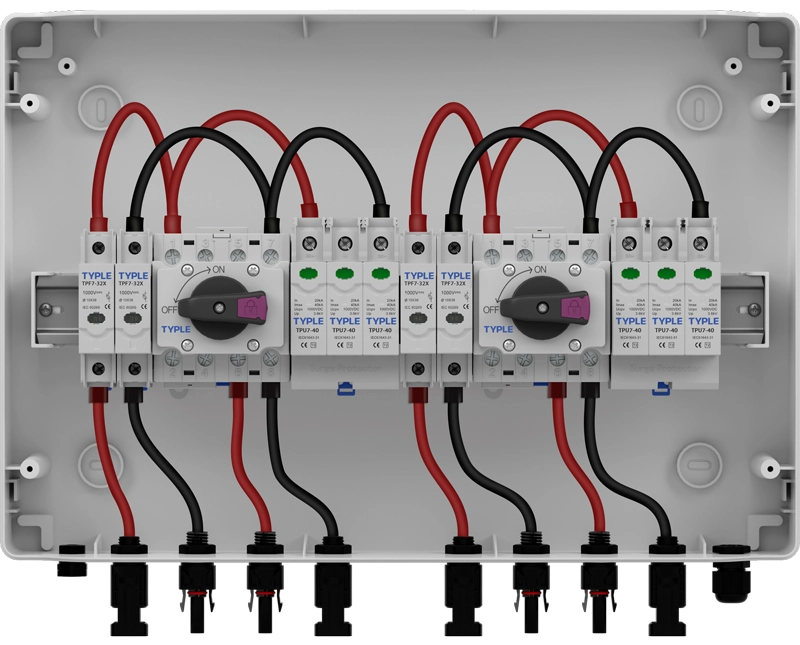
A solar combiner box typically contains four protection components: string fuses, a DC surge protective device (SPD),a DC circuit breaker (MCB), and often a DC isolating switch — all mounted inside an IP65-rated enclosure. Each addresses a different fault type.
- String fuses
— one per string, sized to the string’s short-circuit current; they clear reverse or fault currents on an individual string. (See our DC fuse and DC MCB components.) - DC surge protective device (SPD)
— usually Type 2, rated by nominal discharge current (In) and maximum discharge current (Imax); protects against lightning-induced and switching surges. A combiner box without surge protection leaves the inverter exposed. - DC circuit breaker (MCB / MCCB)
— protects the combined output against overcurrent and provides switching; rated by breaking capacity (Icu) and impulse withstand voltage (Uimp). For a standalone, weatherproof breaker, an enclosed DC MCB box integrates a 2-pole DC circuit breaker in an IP66/IK10 housing. - DC isolating switch
— allows the array to be manually disconnected for maintenance or emergencies.
The enclosure itself matters: an IP65 rating protects against dust and water, and an IK-rated housing resists impact — both critical for outdoor installation in harsh climates.
How to choose and size a solar combiner box
Choosing a combiner box comes down to three parameters: the system’s maximum DC voltage, the number of strings to combine, and the current per string. Match these to the box’s voltage rating, input/output configuration, and fuse and breaker ratings.
Step 1 — Confirm System Voltage
Determine your array’s maximum DC voltage (driven by modules per string and the coldest expected temperature) and choose a box rated at or above it — typically DC600V, DC1000V, or DC1500V. For the difference between the two most common classes, see our guide on DC600V vs DC1000V combiner boxes.
Step 2 — Count Your Strings
The number of strings sets the input configuration. A small residential array might need 2–4 inputs; a commercial array often needs 6, 8, or more. The box is specified as inputs/outputs, e.g. 4/1 or 6/1.
Step 3 — Size the Per-String Current
Each string’s short-circuit current (Isc) determines the fuse rating; the combined current determines the output breaker rating. Fuses and breakers must be DC-rated, not AC.
Step 4 — Set the Protection
Confirm the box includes string fuses, an SPD rated for the system voltage, and a DC breaker or isolator. For outdoor sites, confirm IP65/IK-rated enclosure. A worked example: a small residential system at DC600V with four strings suits a 4-in-1-out DC600V box such as the TYPLE TPX7-P. A larger commercial array at DC1000V with six strings suits a 6-in-1-out DC1000V box such as the TYPLE TPX7-M.
To compare all voltage classes and string configurations, see our full solar power combiner box range.
Common Mistakes When Selecting a Solar Combiner Box
The most common combiner box selection errors come from matching the box by string count alone, while overlooking voltage, current, DC ratings, and enclosure protection. Avoiding the five mistakes below prevents costly rework before installation.
- Choosing by input/output count only.
Selecting a box on string numbers alone, without checking the system voltage, rated current, and the ratings of internal components (fuses, SPD, isolator), often leads to an under-rated box. - Using AC-rated devices in a DC circuit.
Fuses, switches, and breakers rated only for AC cannot safely interrupt DC fault current. Every protection device inside a PV combiner box must be confirmed for DC breaking capability. - Ignoring maximum open-circuit voltage at low temperature.
PV module open-circuit voltage (Voc) rises as temperature drops. Sizing to nominal voltage instead of the maximum Voc at the lowest expected site temperature can push the system past the box’s rated voltage. - Under-rating the enclosure for the environment.
Outdoor installations exposed to rain, dust, humidity, or UV need an enclosure rated at least IP65; a lower IP rating shortens service life in harsh sites. - Overlooking labeling, cable entry, and wiring space.
Insufficient wiring room or the wrong cable entry direction slows installation and maintenance, even when the electrical rating is correct.
Solar combiner box applications
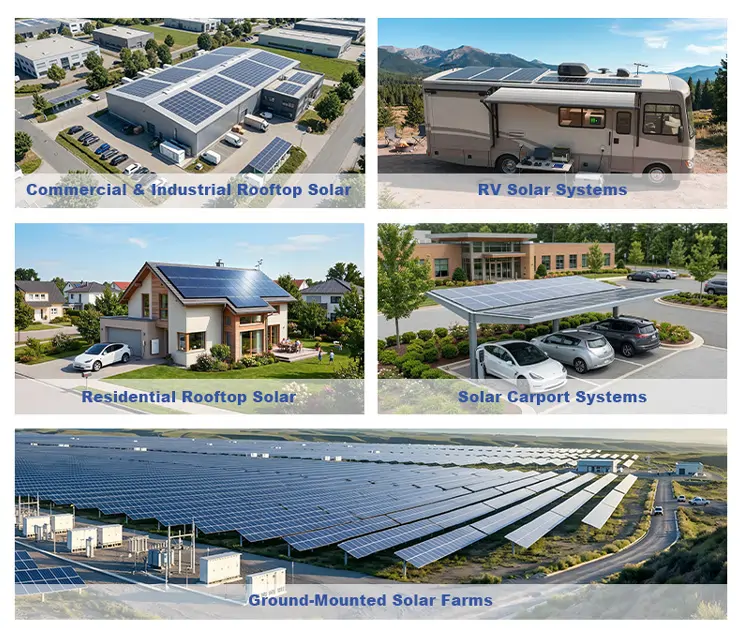
Solar combiner boxes are used wherever multiple PV strings need to be combined and protected: residential rooftops, commercial and industrial (C&I) rooftops, ground-mount arrays, and off-grid or hybrid systems. The right configuration and enclosure rating depend on system size and environment.
- Residential rooftop
— fewer strings, lower voltage (often DC600V class), compact enclosures - Commercial & industrial rooftop
— more strings, DC1000V class, higher input counts - Ground-mount / utility
— large string counts, DC1000V–1500V - Off-grid and hybrid
— combiner integrated with battery and charge-controller protection; common in regions with weak grids.
In high-temperature, high-dust environments such as the Middle East and Africa, the enclosure’s IP65 dust/water rating and wide operating temperature range matter as much as the electrical specs, because the box sits outdoors in direct sun.
Specifying a combiner box for your project
A solar combiner box is the protection and combining hub of a PV array — choosing the right one means matching voltage class, string count, current rating, and enclosure protection to your specific system and environment. You can browse the complete pv combiner boxes range by voltage class and string count, then send your specs for a quote.Get a free quote from TYPLE — send your system specs (string count, voltage, current) and receive a tailored solution within 24 hours.


