
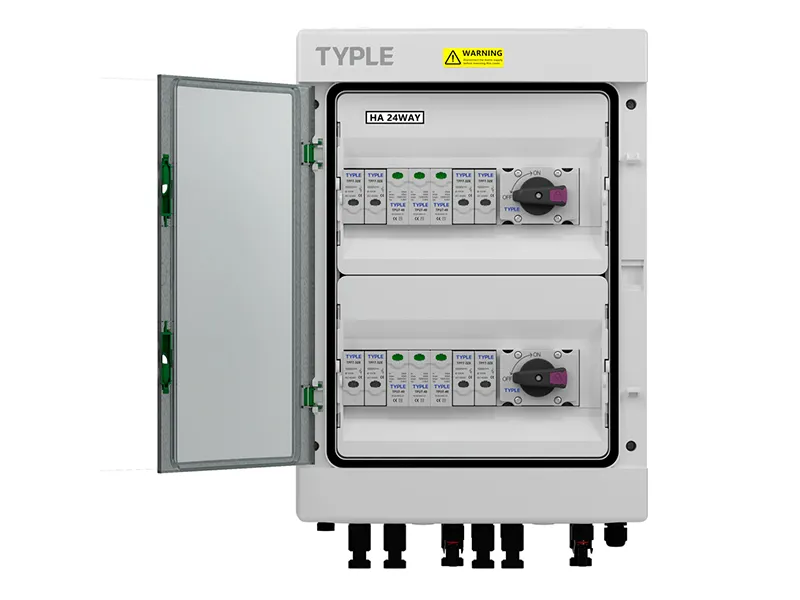
A solar combiner box brings selected PV string circuits together into one or more output groups. A junction box encloses electrical connections, but that term can describe either a box attached to a solar module or an external wiring enclosure. These products have different jobs, and their names alone do not establish which protection functions they contain.
For project buyers, the important comparison is circuit function: does the box terminate module connections, join field conductors, combine strings, or provide a documented combination of these tasks? Selecting by appearance, enclosure size or a supplier’s headline can result in missing protection or an unsuitable inverter connection.
Module Junction Boxes and External Junction Boxes
Module Junction Boxes
A PV module junction box is part of the module assembly, usually on its rear surface. It connects the module’s internal conductors to outgoing leads and commonly contains bypass diodes associated with cell groups. Some module designs distribute this function across several smaller boxes.
Bypass diodes provide a path around affected cell groups under defined operating conditions, helping limit damaging reverse bias. They are not string fuses and do not perform array-level surge protection. They should also not be confused with blocking diodes, which serve a different circuit purpose.
Changing the module junction box is a module repair or manufacturing decision that requires the module manufacturer’s approval. It is not an alternative to installing field equipment between the array and inverter. Ratings, sealing, thermal behavior and compatibility are tied to the module design.
External Wiring Junction Boxes
An external electrical junction box provides an enclosure for terminals, splices or conductor transitions. In a PV installation, it may connect array cables to a different approved wiring method or provide an accessible termination point.
The circuits may remain separate inside it. Alternatively, a specifically designed assembly may connect circuits in parallel. The presence of terminals alone does not establish a combining function, and the word “junction” does not forbid one.
Terms such as array junction box and generator junction box can overlap with combiner-box terminology. Resolve the meaning through the circuit drawing, component schedule and rated operating conditions rather than assuming a universal naming convention.
Solar Combiner Box Functions and Components
A PV combiner box is intended to organize selected string circuits and, where specified, parallel compatible strings. Its output feeds an inverter, charge controller or another downstream DC assembly according to the system architecture.
Possible components include string fuses, terminals or busbars, DC surge protective devices, disconnecting equipment and monitoring modules. The actual configuration varies. Not every product sold as a combiner includes all these devices, and a protection box may pass circuits through without reducing their number.
Combining parallel strings increases the available output current while keeping the operating voltage broadly at the string voltage. It does not independently boost panel efficiency or create additional energy. Any wiring benefit depends on cable lengths, routing, grouping and the inverter’s permitted inputs.
Multiple-output combiners can maintain separate circuit groups. This is particularly important when different groups feed independent MPPT channels. One enclosure does not have to mean one shared electrical bus.
Combiner Box vs Junction Box: Key Differences
| Comparison | Module junction box | External junction box | PV combiner assembly |
|---|---|---|---|
| Main role | Module electrical interface | Enclose field connections | Organize and potentially combine string circuits |
| Typical circuit level | Within one module | Field wiring transition | Array string groups |
| Common contents | Contact rails, leads, bypass diodes | Terminals or approved splices | Terminals, busbars and specified protection |
| String combining | Not its array-level purpose | Only if designed for it | Defined by the circuit arrangement |
| Protection supplied | Module-specific functions | Depends on installed equipment | Depends on the approved component schedule |
This comparison helps classify the equipment, but it does not prove suitability for a particular project. A weather-resistant enclosure still needs suitable DC clearances, terminals, conductor entries and electrical ratings. An enclosure’s IP rating describes ingress protection under its test conditions; it does not certify the internal wiring or fault performance.
Evaluate the complete assembly, including its lowest-rated component. Adding devices to an empty box does not automatically produce a verified PV combiner assembly.
Choosing the Right Box for the PV System
Start by checking whether each PV string can connect directly to its assigned inverter input. An inverter may already provide multiple inputs and some protective functions, reducing the need for external combining. The installation may still require additional isolation, surge protection or cable transitions.
If several strings must be paralleled before reaching an approved input, assess the combined current, reverse-current exposure and required overcurrent protection. A terminal box can perform the connection only when the complete design meets those requirements; a label cannot substitute for that assessment.
For a hypothetical two-string rooftop array, separate strings routed to two independent MPPT channels should remain assigned to their own channels. A field junction box could provide conductor transitions without joining the strings. A common-output combiner could be inappropriate even though it has enough cable entries.
For a larger group of compatible strings feeding one permitted input group, a combiner can centralize string termination and specified protection. Its busbars, output conductors and switching equipment must accommodate the calculated group current.
System power in kilowatts is therefore an incomplete selection rule. Two arrays with similar power can require different boxes because their string layouts and inverter inputs differ.
Requirements for Combiner Box Replacement
A basic junction enclosure is not a direct replacement for a combiner simply because both accept the same cables. Before approving a substitution, identify which functions the original assembly provides and where they would exist afterward.
Review these items:
- Circuit grouping and continuity from each string to its assigned output.
- Required string overcurrent protection and any potential backfeed paths.
- Surge protection locations and coordination with inverter equipment.
- DC switching and isolation duties, where required.
- Terminal, busbar and conductor ratings at the assessed temperature.
- Bonding, insulation and enclosure requirements for the installation.
Protection can be distributed across different equipment where the approved design permits it. What matters is that every required function remains correctly specified, accessible and coordinated.
Connectors and branching adapters also deserve review. Their ratings and compatibility must be confirmed, and they should not be treated as load-break switches. A cable arrangement that fits physically may still overload an inverter connector or defeat intended MPPT separation.

Circuit Specifications for Procurement
A useful request for a solar wiring enclosure states whether circuits remain separate or are combined, how many strings belong to each group, and where each output terminates. Specify the maximum calculated DC voltage and current for each circuit rather than one unexplained system rating.
Request the internal circuit drawing, bill of materials, terminal sizes, enclosure information and applicable assembly documentation. For a box advertised as “four inputs, two outputs,” confirm exactly which inputs feed each output and whether the groups are electrically independent.
Include the installation conditions: indoor or outdoor use, expected temperature, corrosion exposure, mounting arrangement and cable-entry method. For replacement equipment, define functional equivalence before approving a lower-cost alternative.
A clear specification reduces ambiguity between purchasing, engineering and installation teams. It also makes quotations comparable without assuming that every supplier uses “junction box” and “combiner box” in the same way.
Conclusion
The solar combiner box versus junction box comparison becomes clear once the circuit level is defined. Module junction boxes serve the panel, external junction boxes house field connections, and combiner assemblies organize array string groups with specified functions. Select and compare equipment using circuit drawings, ratings and protection requirements rather than names alone.


