
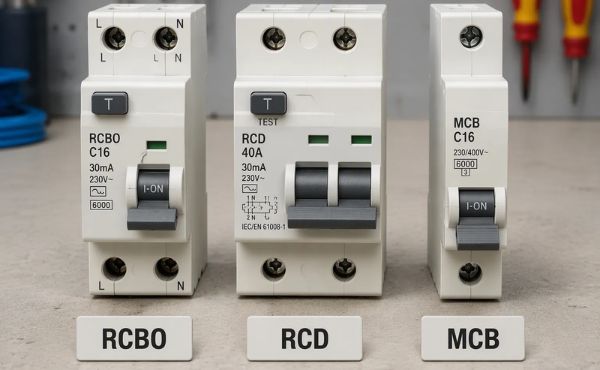
An RCBO combines RCD and MCB protection in one device. An RCD guards against earth leakage, while an MCB guards against overcurrent. This distinction matters in practice for electrical safety, panel space, cost, and code compliance.
Three plain terms make the rest of this comparison easy to follow. Residual current is the small current that flows back to earth instead of returning through the neutral wire. Earth leakage is that stray residual current escaping through a fault or damp path. Overcurrent is any current above a circuit’s rating, covering both overload and short circuits.
The rcbo vs rcd vs mcb choice comes down to the risks each circuit carries. By the end, you should know which device fits your panel and situation.
What Is an MCB?
A miniature circuit breaker, or MCB, is a switch-sized device that automatically cuts power when current rises above a safe level. It sits at the origin of a final circuit inside a distribution board. Electricians reset it by hand after a trip, and no fuse wire needs replacing.
How an MCB Works
Inside the device, current flows through a bimetallic strip and a small electromagnetic coil. A sustained overload heats the strip, and the strip bends until it releases the latch. A sudden short circuit drives a strong magnetic field through the coil, and the coil trips the mechanism almost instantly. This two-part design gives the mcb a response matched to the size of the fault.
The tripping mechanism sits inside a sealed molded case. A toggle lever shows whether the circuit is live, tripped, or switched off manually. The breaker also works as an isolator, so a technician can lock it off before touching wiring.
What an MCB Protects Against
An MCB responds to two fault types: overloads and short circuits. An overload happens when too many appliances draw current through one circuit, and the conductors warm up over time. A short circuit happens when live and neutral touch directly, and the current spikes within milliseconds. The mcb clears both, which makes it the standard device for overload protection and short-circuit protection on final circuits.
One limit deserves emphasis. An MCB does not detect earth leakage. A person touching a live part, or a damaged cable leaking current to ground, will not trip a standard mcb. That gap is why residual current devices exist, and why circuit protection often pairs the two functions. The next sections explain how those devices work and where each one fits.
What Is an RCD?
A residual current device is a protective switch that watches the current flowing in and out of a circuit. It compares the live conductor with the neutral conductor. Under normal conditions, both currents match. A residual current device trips when the two values differ by a small amount.
How an RCD Works
The device passes both conductors through a small magnetic core. Equal currents in opposite directions cancel each other, so the core stays quiet. Any current escaping to earth breaks that balance, and the core produces a signal. A sensing coil detects the signal and releases the trip mechanism.
This sensing method gives the rcd a very different job from a breaker. It does not measure how much current the load draws. It measures only the difference between supply and return. A 30 mA threshold is common for socket circuits in many public standards, and that threshold is chosen to limit the duration of a electric shock. The rcd reacts within milliseconds, well before a person loses muscular control.
What an RCD Protects Against
An rcd responds to earth leakage alone. Typical causes include damaged cable insulation, water ingress, and a person touching a live part. The device also catches residual current that flows through a faulty appliance chassis. This is the basis of shock protection in wet areas such as bathrooms, kitchens, and outdoor sockets.
The rcd does not respond to overload or short circuit. A circuit with only an rcd has no defense against too many appliances drawing current. That gap explains why an rcd is often paired with an mcb, and why the combined rcbo exists. The next section covers that combined device.
What Is an RCBO?
An RCBO is a single device that merges two protective functions in one molded case. The name expands to residual current circuit breaker with overload protection. Electricians also describe it as a residual current circuit breaker with overload protection and short-circuit protection, because the trip mechanism covers all three fault types. It fits the same DIN rail slot as a standard breaker.
How an RCBO Works
The unit holds two sensing systems side by side. A current transformer monitors the balance between live and neutral, just as a standalone residual current device does. A bimetallic strip and a magnetic coil watch the load current for overload and fault spikes. Either sensing path can release the shared trip latch.
This dual sensing explains the internal layout. The rcbo carries both live and neutral conductors through its terminals, and the neutral tail must land on the correct bar. Wiring differs from a simple breaker, so the installer follows the label diagram. A residual current breaker with overcurrent protection also needs its neutral connected to sense leakage correctly. A residual current breaker with overcurrent behaves the same way in service.
What an RCBO Protects Against
One rcbo delivers complete protection from electric shocks, short circuits, and overloads on a single circuit. The leakage sensor handles shock protection and limits the duration of an electric shock. The thermal and magnetic elements handle overcurrent. This makes the device a full circuit protection package for one final circuit.
The combined design removes the coordination problem. A residual current circuit breaker with overload trips on leakage, overload, or a short, and the cause is easier to trace on a dedicated circuit. Residual current protection and overcurrent protection share one lever, so a trip clears both risks at once. That is the practical appeal of the rcbo.
RCBO vs RCD vs MCB Compared
The three devices differ in what they watch, where they sit, and how much rail space they need. A side-by-side view makes the rcbo vs rcd vs mcb choice easier to frame before the panel layout is fixed.
| Device | Protection type | Typical application | Space | Cost | Compliance notes |
|---|---|---|---|---|---|
| MCB | Overcurrent only: overload and short circuit | Final circuits that need overcurrent protection | One DIN rail slot per circuit | Lowest unit cost of the three | Accepted for overcurrent protection; does not satisfy earth-leakage requirements |
| RCD | Earth leakage only | Shared upstream device feeding several breakers; socket circuits and wet areas | One slot, plus a separate breaker for overcurrent | Moderate unit cost; the total rises with the paired breaker | Meets earth-leakage requirements where a separate overcurrent device is present |
| RCBO | Earth leakage plus overcurrent | Dedicated final circuits that need both functions at the origin | One slot per circuit, both functions included | Higher unit cost; often close on installed cost | Meets both requirements in a single device |
Protection, Application, and Space
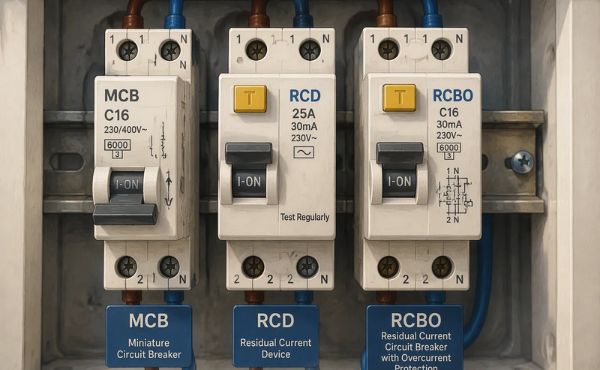
Each row of the table follows from the sensing method inside the case. An MCB watches current draw and nothing else. An RCD watches the balance between live and neutral. An RCBO carries both sensors, so one lever clears every fault type on its circuit.
Application follows the same logic. A shared upstream RCD can feed several breakers, and each breaker then handles its own circuit. The combined unit suits a single final circuit that needs both functions at the origin. The difference between rcd, rcbo, and safety switches comes down to this split between shared and dedicated protection.
Space is the clearest physical marker. The combined unit holds one DIN rail slot per circuit. The split layout needs two slots, or one slot plus a shared device upstream. Compact panels gain room from the combined design, and wide panels absorb the split layout without strain.
Cost and Code Compliance
Unit price and installed cost tell different stories. A combined device carries a higher unit price than a single breaker. The split layout spreads spending across two devices and the links between them. The gap between the two totals often narrows once the full bill of materials is counted. The difference between rcd, rcbo, and safety switches also shapes that bill.
Codes set the floor, not the preference. Many wiring regulations require earth-leakage protection on socket circuits, wet areas, and outdoor outlets. A residual current device meets that requirement, and a separate breaker supplies the overcurrent function. A combined unit meets both requirements in one case. Local rules decide which arrangement a given circuit may use.
An RCD responds only to earth leakage. The RCD does not measure load current. A circuit with an RCD alone has no overcurrent defense. Residual current flows to earth through a fault path, and the leakage sensor reacts to that flow. Shock protection depends on the leakage sensor, and the circuit protection choice follows the fault each device senses.
Comparing rcd and circuit breakers this way keeps the focus on function. The functions, differences, and circuit protection guide above shows where each device fits. Understanding how rcds, rcbos, and safety switches protect you starts with the fault each one senses. Electrical safety then rests on matching the device to the circuit risk, the panel width, and the local code. A qualified electrician confirms the final layout, and the rcbo vs rcd vs mcb decision follows that confirmation.
How to Choose the Right Device
Matching Device to Circuit Risk
Start with the fault each circuit can produce. A dedicated final circuit, such as a single socket run or an outdoor outlet, needs both leakage and overcurrent defense at its origin. That is the clearest case of when to use an rcbo instead of an rcd. One device covers the circuit, and a trip points straight to the cause.
A circuit that only carries fixed equipment with no earth-leakage exposure may need overcurrent protection alone. Here an mcb is the fit. The device watches current draw and clears overloads and shorts. It adds no leakage sensing, so the circuit risk must justify that limit.
Wet areas and socket circuits carry a higher chance of electric shock. Local codes often require leakage protection there. Match the device to that exposure, and let the circuit risk set the baseline for circuit protection.
Combining Devices in One Panel
A shared layout works well in many panels. One main rcd sits upstream and feeds several mcbs, and each breaker serves its own circuit. The rcd supplies shock protection for the group, and each mcb handles overcurrent. This arrangement suits panels with spare rail width and several small circuits.
A panel full of dedicated circuits may favor a combined unit per circuit. Each rcbo carries residual current sensing and overcurrent tripping in one slot. The rcd vs rcbo trade-off then becomes a question of space and fault tracing, not safety.
No layout replaces a site check. Confirm the final choice with a qualified electrician and the local regulations. That step settles the electrical safety question for your panel.
Conclusion
An RCBO delivers combined protection, an RCD watches earth leakage alone, and an MCB handles overcurrent alone. That single split settles most of the rcbo vs rcd vs mcb question.
Match the device to the circuit’s risks, the panel space, the budget, and the local code. A dedicated circuit that needs both functions points toward a combined unit. A shared upstream RCD feeding several breakers suits wider panels. The functions, differences, and circuit protection guide above maps each case.
Electrical safety rests on that match. Confirm the final layout with a qualified electrician and your local regulations before ordering parts.
FAQ
Does an RCBO replace both an RCD and an MCB?
Yes. A combined unit carries leakage sensing and overcurrent tripping in one case. It can replace a separate rcd and breaker pairing on a final circuit. The swap keeps both protections and frees a rail slot. Confirm the layout with a qualified electrician first.
Can I use an RCD without an MCB?
No. An rcd responds to earth leakage alone. It has no thermal or magnetic element for current draw. A circuit protected this way still needs a separate breaker for overload and short circuit. The two devices work as a pair.
How much panel space does each device need?
A single breaker or a combined unit takes one DIN rail slot per circuit. The split arrangement needs two slots, or one slot plus a shared device upstream. Compact panels gain room from the combined design.
Why does the neutral wire matter on these devices?
Leakage sensing compares live and neutral current. The neutral must pass through the device for that comparison to work. A misplaced neutral tail defeats the sensing. Follow the label diagram during installation.
Which device suits a bathroom circuit?
Wet areas carry a higher chance of shock. Local codes often require leakage protection there. A combined unit gives that protection plus overcurrent defense at the circuit origin. The difference between rcd, rcbo, and safety switches comes down to this split between shared and dedicated protection. Electrical safety rests on matching the device to the circuit risk.


