Applications & Solutions
Where TYPLE Electric components actually end up: homes, factories, solar farms, and a few hybrids in between.
What we ship
Two product families. AC final distribution gear for buildings (MCBs, RCCBs, MCCBs, ATS switches, surge protectors,contactors). DC side protection for solar (combiner boxes, PV connectors, DC isolators, DC fuses, DC breakers).Below is how these fit together on real projects, with the model numbers used and the sites they sit on.

1. Residential
A typical home installation pairs a 3 to 10 kW rooftop array with an indoor distribution board. TYPLE covers both sides.
DC side.
The TPX7-P combiner box handles 2 to 6 PV strings at 600 V or 1000 V DC. Inside: string fuses, a DC isolator switch (so the array can be safely disconnected during maintenance), and a Type II surge protector. IP65 enclosure, MC4 compatible glands. Mount it on an exterior wall close to the inverter, ideally within 1.5 m, to keep DC cable runs short.Reference: an 8 kW rooftop in New South Wales, Australia, commissioned March 2024. One TPX7-P 2/1 DC 600 V unit, two strings of 12 panels each. The system covers daytime AC,lighting, and kitchen loads,with surplus exported to the grid.
AC side.
Where the same project needs AC final-distribution gear (MCBs, RCCBs, and arc-fault protection for the consumer unit), TYPLE can supply it alongside the DC side, so the combiner box and the distribution board ship on a single PO.
2. Commercial & Industrial
C&I sites usually run 50 kW to several MW. More strings, longer cable runs, higher fault currents. The workhorse is the TPX7-M combiner box at 1000 V DC. One enclosure accepts up to 24 PV string inputs. Internal fuses (typically 15 A or 20 A gPV), DC MCCB (TPM7n series, 100 to 800 A), DC isolator, Type II DC SPD. Cold rolled steel cabinet with outdoor powder coating. Operating range −25 °C to +60 °C, IP65.
Three live projects:
- Nakhon Ratchasima, Thailand.
50 kW farm rooftop, May 2024. One TPX7-P 6/1 DC 1000 V box. Powers fans, irrigation pumps, cold storage. - Binh Duong, Vietnam.
500 kW manufacturing rooftop, August 2023. Four TPX7-M 8/1 DC 1000 V boxes, zoned to match the MPPT inputs of two 250 kW string inverters. Daytime self consumption covers most production load. - Île de France, France.
120 kW solar carport, January 2025. Two TPX7-M 6/1 DC 1000 V boxes. Feeds tenant EV chargers during the day, the LV grid in the evening.
For the AC side of a C&I building, TYPLE can also supply the MCCBs, modular contactors, and transfer switches that pair with the PV system, keeping the DC and AC scope on one order. Specifications are matched to the project on request.
3. Utility scale solar
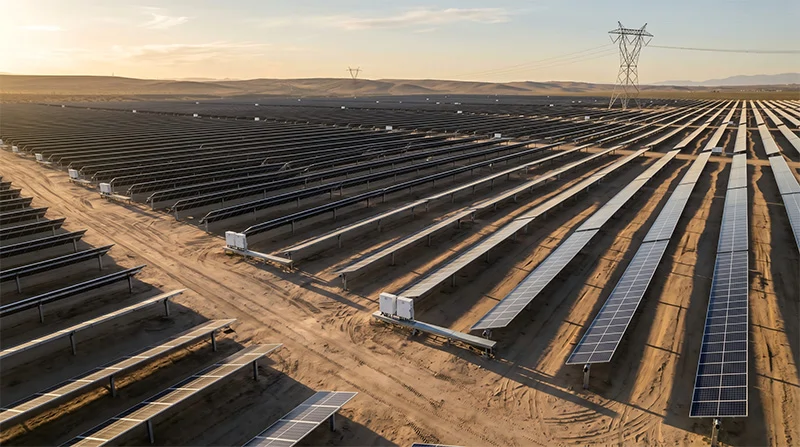
The industry moved from 1000 V to 1500 V DC for one reason: cost. Going to 1500 V cuts the number of strings per MW by roughly a third. Fewer combiner boxes, less copper cable, fewer trenches. On a 50 MW project, that adds up to six figure euros saved on balance of system alone.
For projects moving to 1500V, the TPX7-M platform can be configured to 1500V DC on a custom-order basis.These configurations are built to order against the project’s array layout and site conditions:
| Inputs | Outputs | Typical use |
|---|---|---|
| 8 | 1 | Small ground mount sections |
| 12 | 1 or 2 | Standard utility blocks |
| 16 | 1 or 2 | Large blocks, central inverters |
| 24 | 2 or 3 | Maximum density, central inverter feeds |
Inside: 1500 V gPV fuses, DC MCCB rated 1500 V, optional motorized DC isolator, Type I+II DC SPD with remote signaling contacts. Standard enclosure is powder coated cold rolled steel. For coastal sites within 1 km of the sea, we substitute galvanized steel with a C5-M coating system. For desert deployments, IP66 with sand resistant gland plates. Design life is 25 years, matching panel warranties. The two parts that actually wear are the SPDs (replaced once after a major lightning event in most installations) and the DC isolator contacts (rated for 1,000+ operations under load).
4. Specialized projects
A few project types don’t fit cleanly into the three buckets above. Solar carports. Sunshade plus generation, usually 50 to 500 kW. The 120 kW Île de France project above is a good template. Watch out for voltage drop on the long horizontal cable runs between the carport and the building’s electrical room. Siting combiner boxes close to the array helps. Agro PV. Panels mounted above crops, with generation supporting irrigation pumps, cold storage, small processing equipment. Our 300 kW project in Central Luzon, Philippines (October 2023) uses three TPX7-M 8/1 DC 1000 V boxes. A priority circuit feeds the village committee office, street lighting, and a small rice processing facility. Stability matters more than peak performance for these sites. EV charging integration. DC combiner boxes can feed DC fast chargers directly when paired with a DC/DC stage, bypassing inverter losses. Less common than AC coupled designs, but worth specifying early if the option is on the table. Hybrid PV + battery storage. Adds a battery DC isolator and a separate Type II SPD on the battery side. Talk to us early. Storage layouts vary widely between vendors, and retrofitting protection later is more expensive than designing it in.
What we do beyond shipping boxes
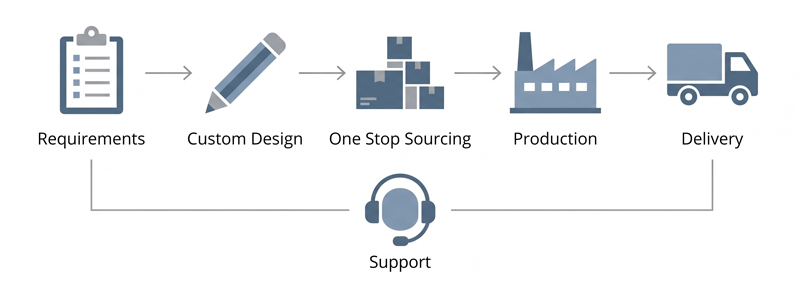
Three things tend to separate a good supplier from a cheap one on PV projects. Custom layouts. The standard TPX7-M is a starting point, not a final spec. We swap fuse ratings, add per string monitoring, change enclosure colors and ID markings, or relocate the DC isolator to suit panel layouts. Catalogue dimensions are not commandments. One PO covers DC and AC. Most EPCs end up with three to five suppliers for a single substation: combiner box, MCCB, ATS, SPDs, contactors. TYPLE ships all of these. One delivery, one set of certifications, one invoice. Engineering answers from engineers. Technical questions go to people who can answer them. Most replies inside 24 hours from [email protected].